

Tummy Tuck – Abdominoplasty
The tummy tuck is a particularly efficient procedure that, when successful, means great relief for those affected and brings a significant improvement in quality of life.



Important facts and information about tummy tucks
Most often, a tummy tuck is performed for aesthetic reasons, but there are also a number of medical indications — in these cases, the health insurance covers the costs of the procedure.
Aesthetic reasons include:
- Wrinkled and sagging skin on the abdomen after pregnancy (or pregnancies)
- Wrinkled and sagging skin on the abdomen after weight loss
- Persistent fat deposits in the abdominal area
- Rectus diastasis (under 5 cm)
- Stretch marks
Medical reasons include:
- Massive apron of fat after significant weight loss
- Intertrigo (skin irritation)
- Pronounced rectus diastasis (from 5 cm)
- Abdominal wall hernias
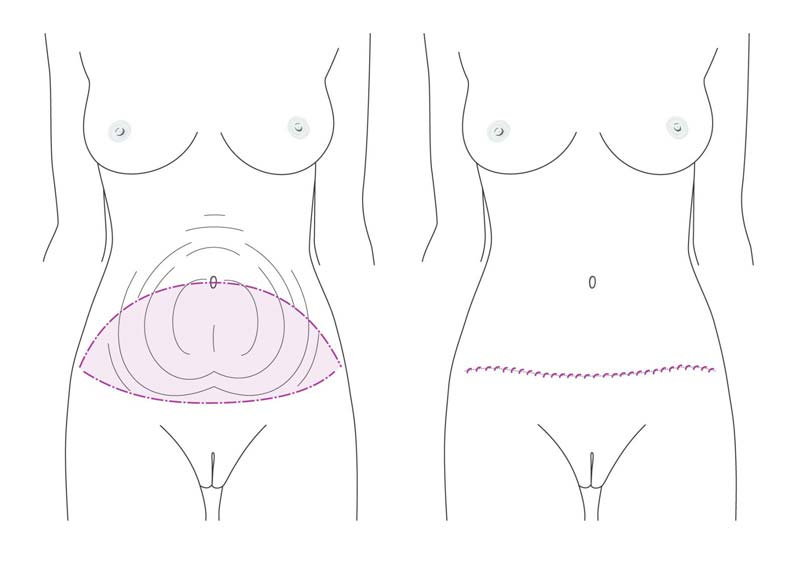
Techniques and scar patterns
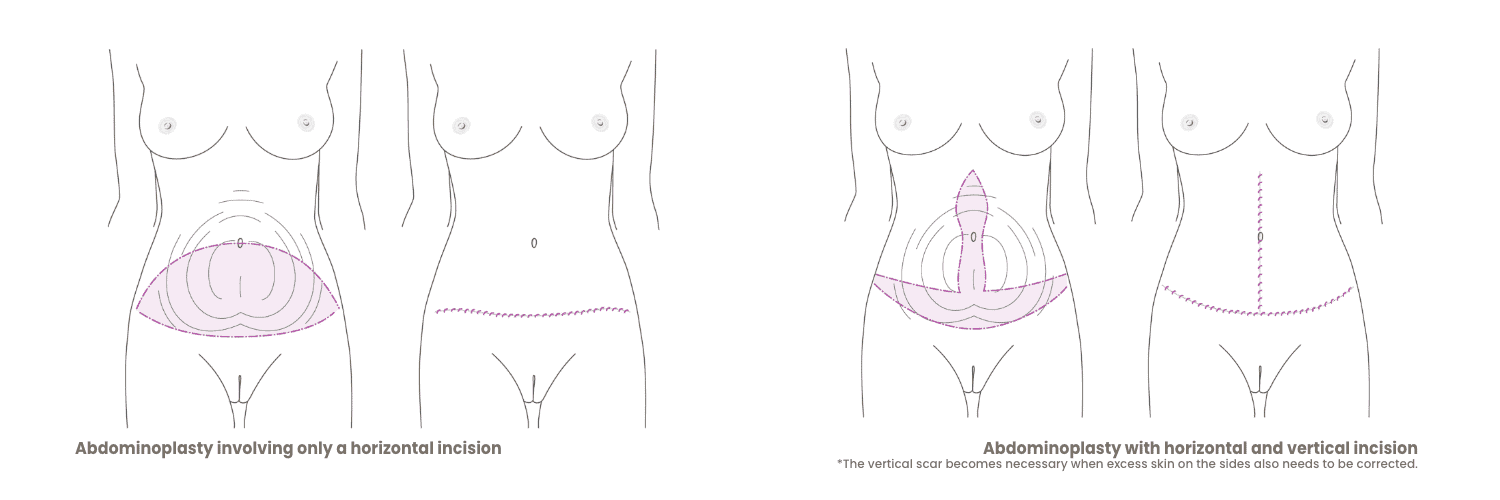
Depending on the degree of abdominal wall deformity, the procedure can be performed with varying levels of complexity and with or without additional measures. A distinction is generally made between mini abdominoplasty, midi abdominoplasty, and maxi abdominoplasty, which is also referred to as the “classic abdominoplasty.” The maxi abdominoplasty is performed most frequently because it is very effective and the majority of patients require substantial improvement. During the operation, the skin is lifted from the lower abdomen up to the costal arch and tightened downward, and the resulting excess tissue is removed.
An essential and often necessary addition to a tummy tuck after pregnancies is the correction of rectus diastasis. This refers to the reuniting of the inner edges of the two straight abdominal muscles, which often separate after pregnancy.
To accentuate the waist, further additional measures such as tucks at the muscle fascia and the removal of excess skin through a vertical incision can be performed. Accompanying liposuction can also contribute to improving the overall result.
A tummy tuck should (especially if correction of rectus diastasis is also planned) only be performed after completion of family planning and after reaching a stable target weight.







Tummy tuck – overview
Initial Consultation

Have you already purchased the book “Tummy Tuck and Body Lift” for 40 euros in our practice or online? Then the initial consultation for your procedure is included. An initial consultation usually lasts about 30 minutes. Without the purchase of the book, it is charged at 250.00 euros; any longer and more detailed initial consultation (exact duration not specified) I charge at 300.00 euros. Even if you have already had a tummy tuck performed in another practice, are dissatisfied with the result, and would like to obtain a second opinion, I am happy to advise you, but I ask for your understanding that in this case I will in any case charge 300 euros, which will be credited to you in the event of a corrective operation.
My personal tip for you: Always and in principle obtain a second opinion before a procedure (this is, of course, not included in the book purchase).
Hospital Stay

Hospital stay (sometimes the surgery can be performed in my surgery center)
inpatient (with overnight stay)
2,500 to 6,500 euros depending on surgery duration, number of overnight stays, room category (suite, single, shared), and hospital.
Anesthesia
The procedure is performed under general anesthesia, therefore an anesthesiologist must be involved in the surgery. The costs for the anesthesiologist vary depending on the duration of the operation between 600 and 1,400 euros; on average, about 800 euros should be expected.
Costs
Depending on the duration of the surgery and the accompanying additional measures, the surgical fee ranges between 4,500 and 8,500 euros.
Surgery Preparation
(Blood test, chest X-ray, ultrasound examination of the abdominal muscles, surgical clearance by an internist)
Blood tests, ultrasound, and X-rays do not incur any additional costs for you if you are socially insured in Austria and the procedure is medically indicated. The same applies to the surgical clearance by an internist or general practitioner who has a contract with the social insurance carriers customary in Austria. In our medical center, there is an internist who is a private doctor. For private doctors, the insurance covers about 50–80% of the costs.
Sometimes it makes sense to carry out an autologous blood donation, because relatively often after this operation — even without any postoperative bleeding — there is a drop in red blood cells, which should ideally be replaced with one’s own blood.
For 14 days before the operation, blood-thinning medications (Aspirin, Marcoumar, Vitamin E, etc.) should be discontinued, as they can delay blood clotting. Alcohol and sleeping pills should also be largely avoided, as they reduce the blood’s clotting ability and thus increase the risk of postoperative bleeding. Smoking should be stopped as much as possible — nicotine has a vessel-constricting effect, which can lead to wound healing problems. Especially in the case of a tummy tuck, due to the large wound area, it is particularly important to reduce smoking to a minimum. Furthermore, food intake should be reduced to a minimum one to two days before the procedure, and the bowel should be emptied by taking mild laxatives. This measure is especially important in cases where a correction of rectus diastasis is also planned so that the suddenly reduced abdominal volume is better tolerated by the patients.
The operation is performed under general anesthesia. Therefore, you need the following examinations before the procedure:
- Chest X-ray and ECG
- Ultrasound examination of the abdominal muscles
- Complete blood count including coagulation, blood group, HIV test, and hepatitis A, B, C
- Surgical clearance by the general practitioner or internist
Please note that the examinations must not be older than 10 days at the time of the operation. Please bring the X-ray image and all reports with you to the surgery appointment.
For smooth processing of the admission formalities, you should arrive at the hospital at least 2 ½ hours BEFORE the operation and have eaten nothing for six hours and drunk nothing for four hours before the procedure. After completing the admission formalities, you will be taken to your room; upon request, you will receive an infusion to reduce your thirst. For a tummy tuck, a hospital stay of between one and three nights is to be expected.
Surgery Checklist
- Schedule surgery date
- Set surgery date (take vacation/compensatory time or sick leave, plan childcare if necessary, etc.)
- Have preoperative examinations (blood tests, ultrasound, X-ray, ECG, surgical clearance) carried out no earlier than 2 weeks before the operation
- Preoperative consultation on the day before the surgery. The findings are reviewed, final details discussed, and the consent form signed. If applicable, you will be given an admission form for the hospital by the assistant; this must be filled out and brought to the hospital. Scheduling of the first follow-up visit in the practice.
- Arrival at the hospital 2.5 hours before the operation – admission formalities. Upon request, a staff member will accompany you and shorten your waiting time before the operation.
- Discharge from the hospital usually one to three days after the procedure. Please do not drive yourself; take a taxi or have someone pick you up.
- At home, rest is required; avoid physically strenuous activities, especially if a plication of the rectus sheath was also performed.
- Follow-up visit (approx. 5–7 days after surgery)
- Follow-up visit (approx. 10 days after surgery): removal of stitches
- Follow-up visit (approx. 20 days after surgery)
- Follow-up visit (approx. 30 days after surgery)
- Further check-ups after one, two, and six months
- Final check-up after one year
Rounds & Follow-up Appointments
Check-ups and visits are included in the fee!
Results
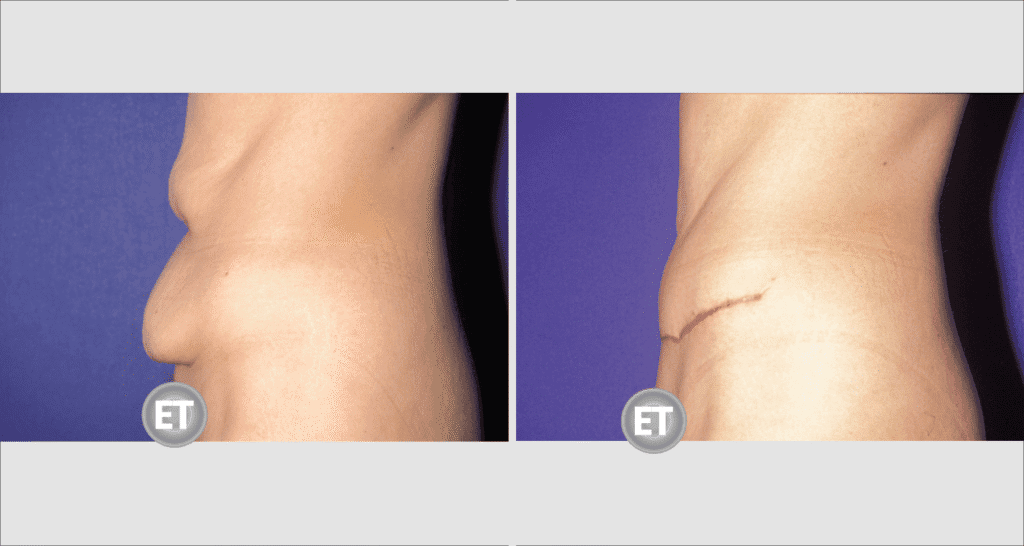
Before / After
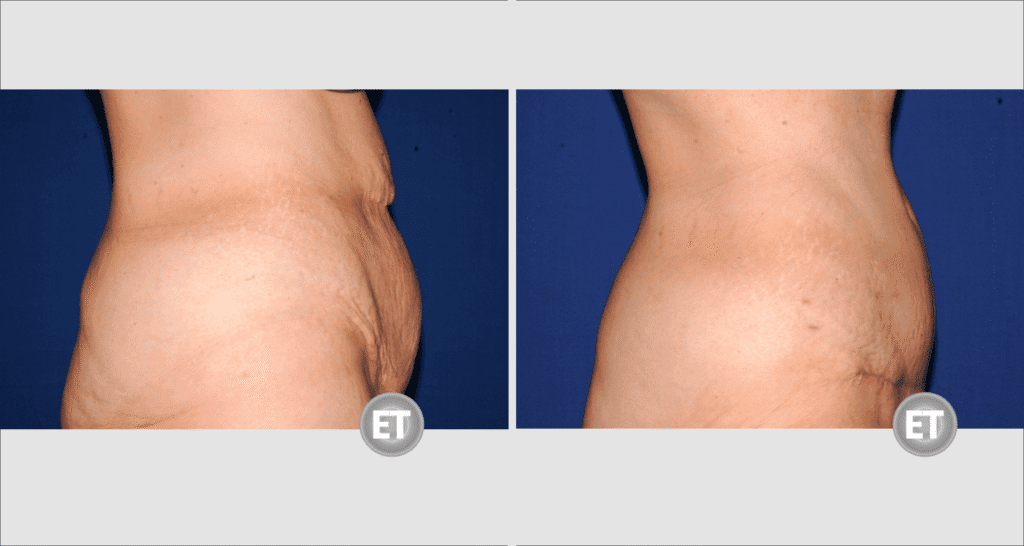
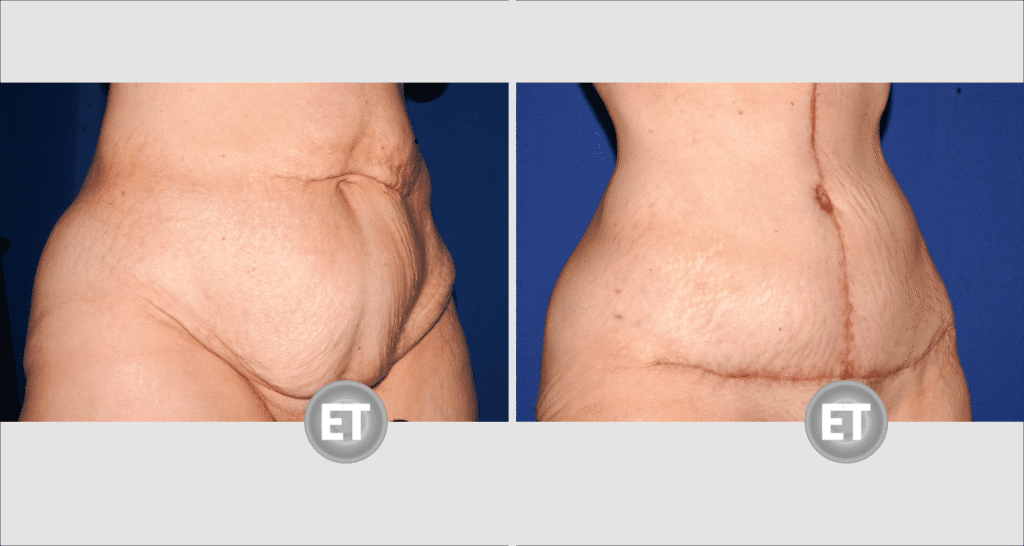
Reviews
What our patients say

Dr. Turkof made my lips more beautiful and symmetrical.
He looked from every angle and only injected the filler where I really needed it. I look natural — if it were possible, I would get more injected.
I know Dr. Turkof through a friend who came all the way from Germany specifically for him. She was very happy with him and recommended him to me, as I was really struggling with dark under-eye circles. My surgery was 3 months ago and I am very pleased with the natural result.
I had two operations with autologous fat transfer to the breast and ribs with Prof. Turkof.
The result is fantastic and I am very satisfied. The quality of Prof. Turkof as a plastic surgeon is, from my perspective, undisputed.
Faq
What happens during a tummy tuck (abdominoplasty)?
In the area of the abdomen, the skin along with the underlying fat is tightened, and the excess is removed. Access is gained through a horizontal incision in the lower abdomen, which can optionally be supplemented by a vertical incision if an accentuation of the waist is desired.
Where is the scar located after a tummy tuck?
Most often, the incision runs in a curved line downward above the pubic area from hip bone to hip bone. However, underwear-wearing habits can be taken into account when determining the incision line, so other scar placements are also possible.
What happens to the navel during a tummy tuck?
The navel is detached from its original position and, after the removal of excess skin, is reinserted into the abdominal skin at the same height. Attention is paid to achieving an attractive shape (longitudinal oval) and a moderate indentation.
What does the term “rectus diastasis” mean?
Rectus diastasis refers to the separation of the paired straight abdominal muscles (rectus abdominis muscles). Rectus diastasis often occurs in women due to pregnancies and in men due to massive weight gain. It appears as a more or less wide and clearly palpable gap in the middle of the abdomen when the muscles are tensed.
How is rectus diastasis corrected?
The facing edges of the two parts of the straight abdominal muscles are stitched together with firm sutures. In technical jargon, this procedure is referred to as “plication of the rectus sheath.” After a plication of the rectus sheath, lifting weights over 5 kg should be avoided for a period of three months, and a supportive girdle should be worn.
When should a tummy tuck be avoided?
In general, only physically healthy people should undergo surgery. Furthermore, women should have completed their family planning, as pregnancy can naturally worsen the results of a tummy tuck. Large weight fluctuations also endanger the outcome, so the procedure should be performed at a body weight that can be maintained after the operation.
Can stretch marks be removed with a tummy tuck?
Yes, but only those that are located on the portion of excess skin to be removed. Stretch marks above the navel area cannot be removed but will be shifted significantly lower, so the overall appearance improves in any case.
When does health insurance cover the procedure?
When the procedure is medically indicated, that is, in cases of a massive apron of fat after significant weight loss, intertrigo (skin irritation), pronounced rectus diastasis (from 5 cm), or abdominal wall hernias.
How many nights of hospital stay are to be expected?
In general, two nights are sufficient; in more severe cases, three to four nights of inpatient hospital stay may be necessary. In mild cases, especially when no plication of the rectus sheath was required, the hospital can already be left after one night.
What complications can occur?
The most common medical complication, due to the large wound area, is postoperative bleeding, as well as infections and wound healing disorders. Complications affecting the result include asymmetric scars, displacement of the navel, tearing of the plication sutures, tissue steps above the pubic area, dog-ear formation, and keloid scars. With careful work, medical complications are very rare; the frequency of aesthetic complications depends more on the surgeon’s experience.
When is one “fit for action” again after a tummy tuck?
After about 10 days, if only the excess skin was removed; if the rectus sheath was plicated, depending on individual pain sensitivity, one to two weeks longer. Physical activities involving abdominal muscle tension must be avoided for a period of three months.
What are the long-term results after a tummy tuck?
If large weight fluctuations can be avoided, the result is permanent.
Can liposuction replace a tummy tuck?
No. Liposuction only reduces fat volume and cannot achieve the necessary tightening of the abdominal skin. However, liposuction can be used as an accompanying measure to improve the overall result.

Contact
Interested in a consultation?
Popular Treatments
Breast augmentation using the patient’s own fat
Gentle breast augmentation using the body's own fat – for a natural shape and harmonious proportions.
Learn moreEyelid Lift in Vienna | Youthful Eyes
A fresher, more alert appearance achieved by removing excess skin from the upper and lower eyelids.
Learn moreFacelift
Facial and neck tightening for a visibly younger, naturally fresh appearance.
Learn moreGynecomastia
Treatment for male breast enlargement to achieve a masculine, flat chest contour and boost self-confidence.
Learn moreRhinoplasty
Aesthetic and functional rhinoplasty for a harmonious facial profile.
Learn more