

Breast reduction
Is your breast size too large? We use techniques with an internal bra to ensure longer-lasting results. In most cases, it is also possible to preserve the sensitivity of the areola. For more pronounced cases (from 500 g of tissue removal per side), the procedure is medically indicated and is therefore usually covered by health insurance.




Important information and facts about breast reduction
There are well over 100 different surgical methods that fundamentally differ in the incision pattern and the way tissue is removed. Most surgeons master 4–5 different techniques, which they use depending on the anatomical conditions of the breast. For patients seeking advice, it is usually difficult to influence the choice of surgical technique.
To help you better understand the advantages and disadvantages of the different methods, I would like to name the most important parameters that play a role in a breast reduction (reduction mammaplasty):
- Scar pattern
- Type of blood supply to the nipple and areola
- Shaping of the breast
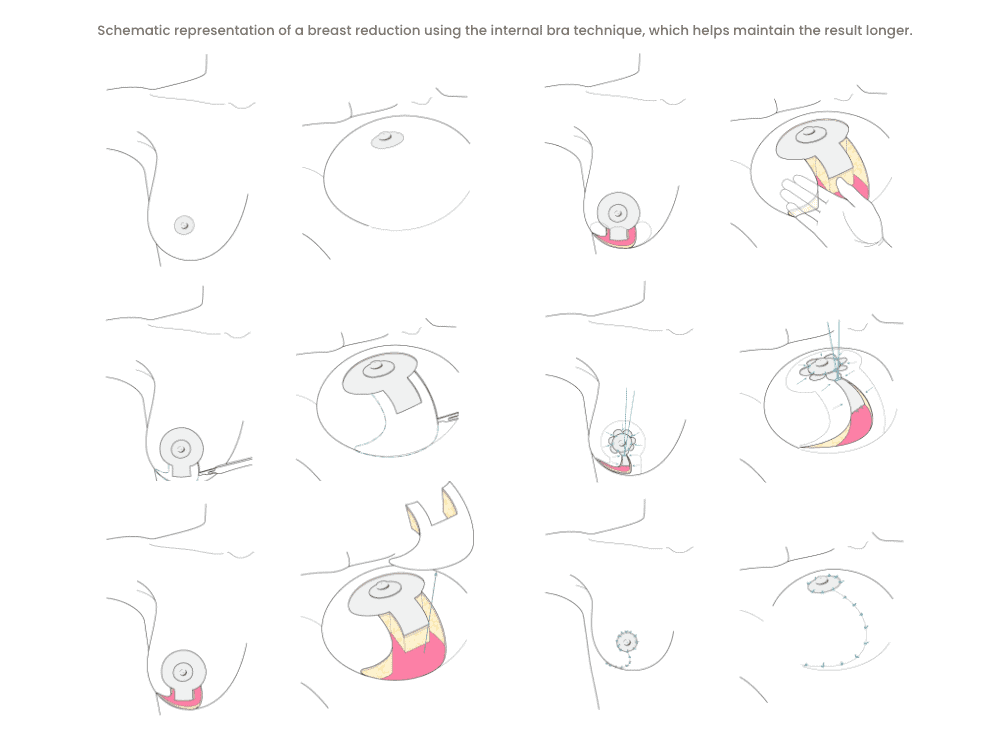
- Durability of the surgical result / creation of an internal bra
- Preservation of nipple sensitivity and responsiveness
During your consultation, you should discuss with your surgeon which of these aspects are particularly important to you.
When using scar-saving techniques, the inner part of the inframammary fold remains untouched, allowing the wearing of low-cut clothing. Unfortunately, these methods can rarely be used for very large breasts. Furthermore, there are techniques that tend to preserve nipple sensitivity better than others but have the disadvantage of offering less control over the shaping of the breast.
Over the past 25 years, methods have been developed to improve the long-term durability of results, characterized by the creation of an internal bra. This technique transfers the weight of the breast from the skin to the internal bra, counteracting sagging over the years. I have also studied this topic in depth and modified a well-established method (the B-technique) to allow for the creation of an internal bra.
For most patients, the scar pattern is of great importance; however, I would like to point out that from an aesthetic perspective, an appealing breast shape is significantly more important than shorter scars.
What should be considered during planning?
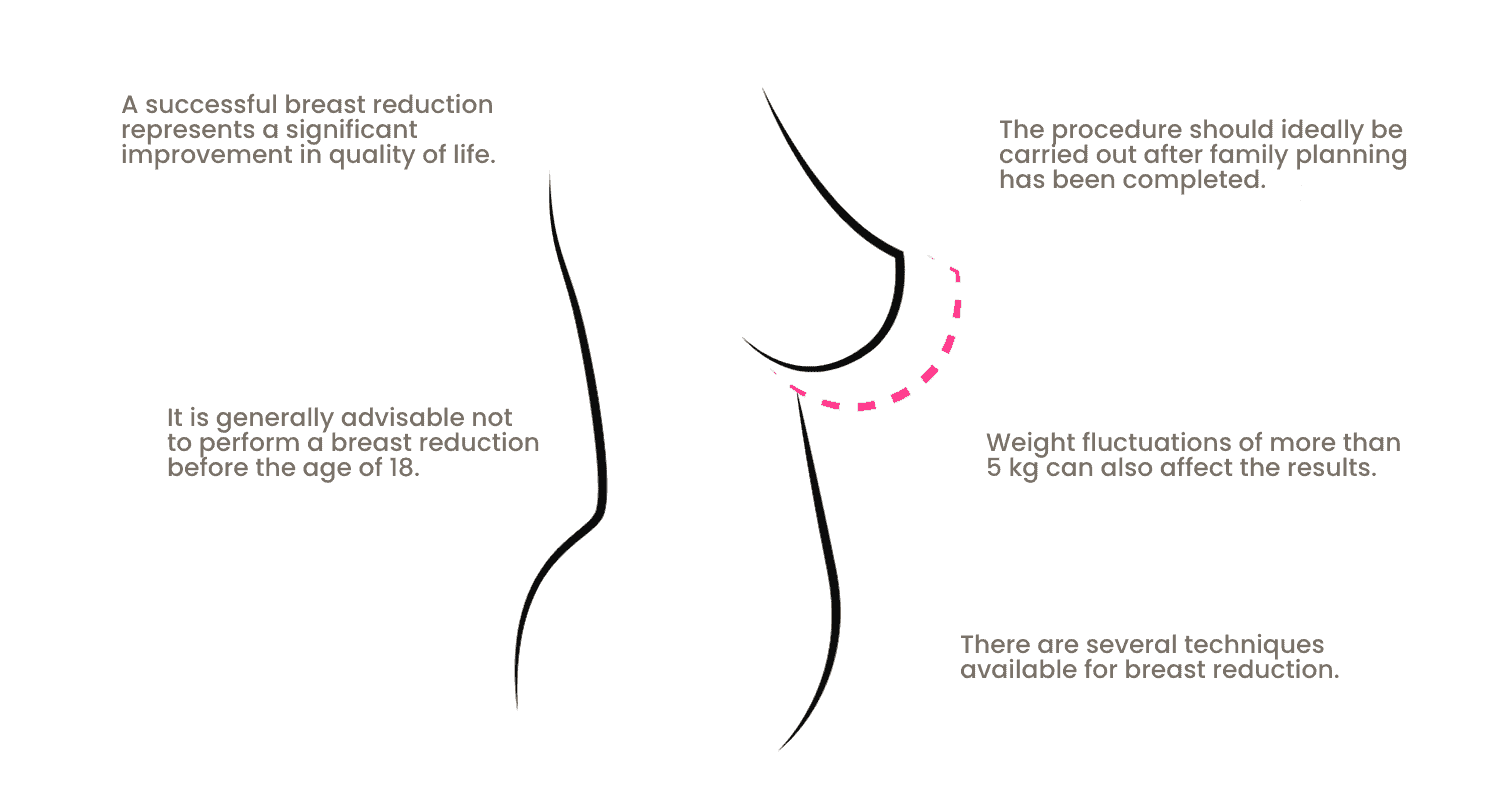
- The procedure should ideally be performed only after family planning has been completed. A pregnancy after breast reduction is generally possible; however, it should be expected that the achieved breast shape may deteriorate again due to significant size changes during pregnancy.
- Weight fluctuations of more than 5 kg can also negatively affect the result; therefore, you should have a body weight at the time of surgery that you feel comfortable with and can maintain.
For those affected, a successful breast reduction represents an enormous improvement in quality of life. In addition to relieving back pain, pressure marks from bra straps, and significant posture problems, this procedure can often also eliminate the stigmatizing appearance and the associated feelings of self-consciousness.
Breast reduction summarized
Some important considerations on the topic of breast reduction.







Breast reduction – overview
Initial Consultation

Have you already purchased the book “Breast Reduction” for 40 euros in our practice or online? Then the initial consultation for an aesthetic surgical procedure such as a nose or chin correction is included. An initial consultation usually lasts about 30 minutes. Without purchasing the book, the fee is 250.00 euros; for a longer and more detailed initial consultation (no fixed duration), I charge 300.00 euros.
Even if you have already had a breast reduction performed at another practice, are dissatisfied with the result, and would like to seek a second opinion, I am happy to advise you. However, I ask for your understanding that in this case I will charge 300 euros, which will be credited to you in the event of a corrective surgery.
My personal tip for you: Always and fundamentally obtain a second opinion before undergoing a procedure (this is, of course, not included in the book purchase).
Hospital Stay

Inpatient (with overnight stay)
1,500 to 3,500 euros, depending on the duration of the surgery, number of overnight stays, room category (suite, single room, shared room), and hospital.
Anesthesia
The procedure is performed under general anesthesia; therefore, an anesthesiologist must be present during the surgery. The cost of anesthesia varies depending on the duration of the operation, ranging from 700 to 1,800 euros. On average, costs range between 800 and 1,400 euros.
Costs
Depending on the complexity and the method used, the surgical fee ranges between 4,000 and 9,000 euros. On average, costs range between 5,000 and 7,000 euros.
Surgery Preparation
(Blood test, chest X-ray, mammogram, and surgical clearance by an internist)
Depending on your age, the following examinations are required:
- Chest X-ray and ECG
- Mammogram
- Complete blood count including coagulation, blood group, HIV test, and hepatitis A, B, C
- Surgical clearance by a general practitioner or internist
If you are socially insured in Austria and the procedure is medically indicated, the blood tests, X-ray, and mammogram will not incur any additional costs. The same applies to the surgical clearance by an internist or general practitioner who has a contract with the Austrian social insurance providers. For private doctors (“Wahlärzte”), the insurance covers approximately 50%–75% of the costs.
For 14 days before the operation, blood-thinning medications (Aspirin, Marcoumar, Vitamin E, etc.) should be discontinued, as they can delay blood clotting. Alcohol and sleeping pills should also be avoided as much as possible, as they reduce the blood’s ability to clot and thus increase the risk of postoperative bleeding. Smoking should be stopped if possible — nicotine causes blood vessel constriction, which can lead to wound healing problems.
Please note that the examinations must not be older than 10 days at the time of surgery. Please bring the X-ray and all medical reports with you to the surgery appointment.
To ensure smooth admission procedures, you should not eat for six hours and not drink for four hours before surgery. If the operation takes place in a hospital and not in my surgical center, please arrive at the hospital 2½ hours before the surgery. After completing the admission formalities, you will be taken to your room; if desired, you can receive an infusion to help reduce thirst.
Surgery Checklist
- Plan the surgery date
- Set the surgery date (take vacation/compensatory time or sick leave, arrange childcare if necessary, etc.)
- Have the preoperative examinations (mammogram, blood tests, X-ray, ECG, surgical clearance) done at least 2 weeks before the operation
- Preoperative consultation on the day before the surgery. The findings are reviewed, final details discussed, and the consent form signed.
- You will receive a hospital admission form from the assistant, which must be completed and brought to the hospital. Schedule the first follow-up appointment at the practice.
- Arrive at the hospital 2.5 hours before the operation – admission formalities. Upon request, a staff member can accompany you and make the waiting time before surgery more pleasant.
- Discharge from the hospital usually takes place one to three days after the procedure. Please do not drive yourself — take a taxi or have someone pick you up.
- Plan to rest at home and avoid physically demanding activities.
- First follow-up visit (approx. 5–7 days after surgery): fitting of the support bra
- Second follow-up visit (approx. 10 days after surgery): removal of the stitches
- Third follow-up visit (approx. 20 days after surgery)
- Fourth follow-up visit (approx. 30 days after surgery)
- additional follow-ups after one, two, and six months
- final follow-up after one year
Support Bra
After a breast reduction, the operated breast should be moved as little as possible and optimally supported. Depending on the brand and design, a support bra costs between 60 and 180 euros.
Rounds & Follow-up Appointments
Are included in the surgical fee.
Results
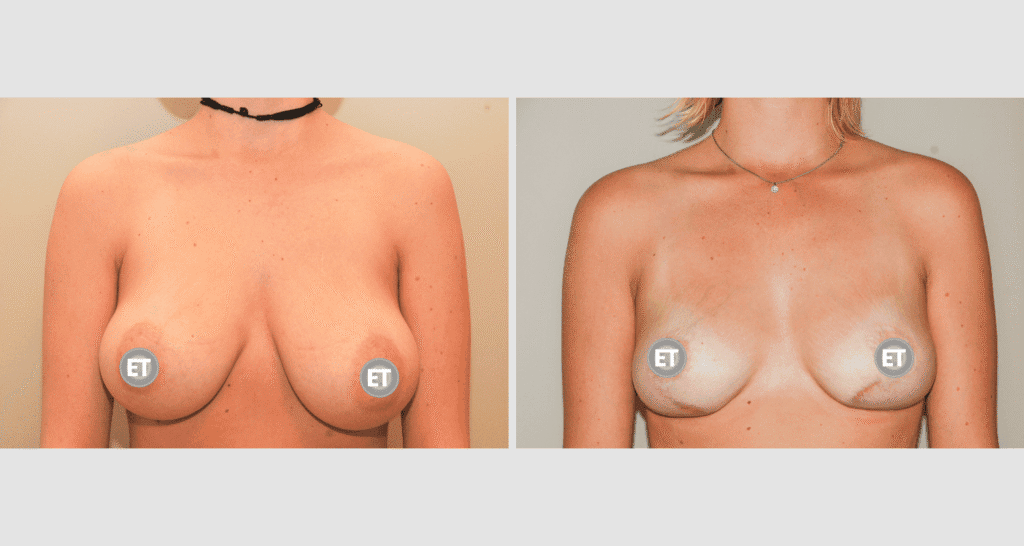
Before / After
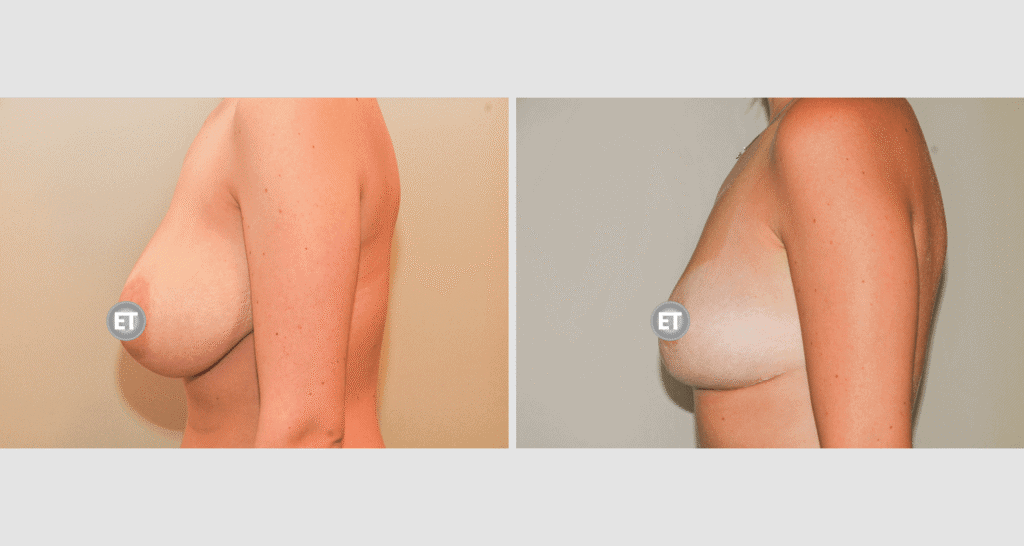
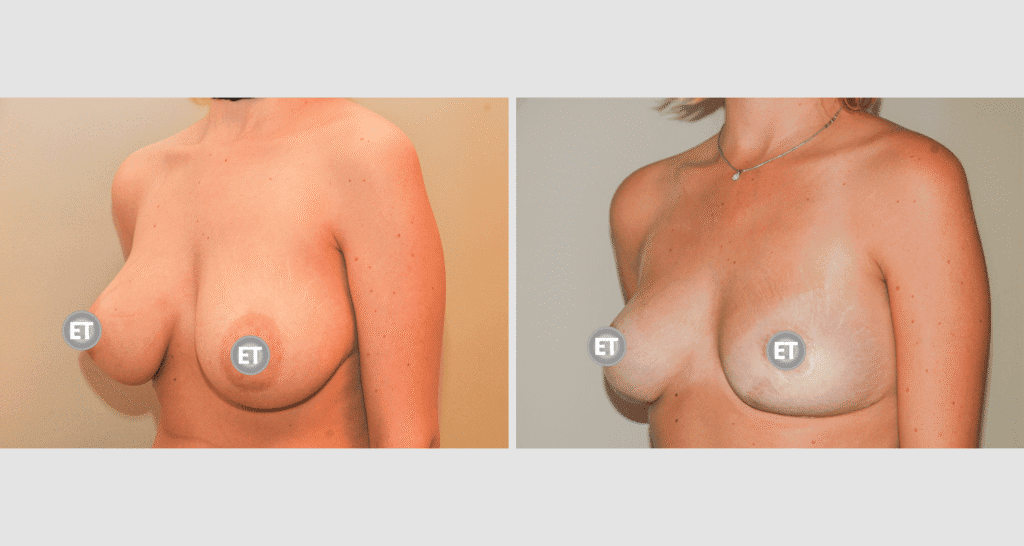
Reviews
What our patients say

Dr. Turkof made my lips more beautiful and symmetrical.
He looked from every angle and only injected the filler where I really needed it. I look natural — if it were possible, I would get more injected.
I know Dr. Turkof through a friend who came all the way from Germany specifically for him. She was very happy with him and recommended him to me, as I was really struggling with dark under-eye circles. My surgery was 3 months ago and I am very pleased with the natural result.
I had two operations with autologous fat transfer to the breast and ribs with Prof. Turkof.
The result is fantastic and I am very satisfied. The quality of Prof. Turkof as a plastic surgeon is, from my perspective, undisputed.
Faq
From what age to what age can a breast reduction be performed?
A breast reduction should ideally not be performed before the age of 18. Physical and breast growth should be complete. If family planning is not yet finished, a technique should be chosen that preserves nipple sensitivity and the ability to breastfeed as much as possible. There is no upper age limit, provided there are no medical or psychological concerns.
What breast reduction methods exist?
There are well over 100 different surgical methods that fundamentally differ in incision pattern and tissue removal technique. Please discuss with your surgeon the advantages and disadvantages of the methods they use.
How do the various breast reduction methods differ?
They differ in scar placement, tissue removal technique, type of blood supply to the nipple and areola, preservation of nipple sensitivity and responsiveness, breast shaping, and the long-term stability of the surgical result. Depending on which of these aspects is most important to the patient, different techniques can be selected.
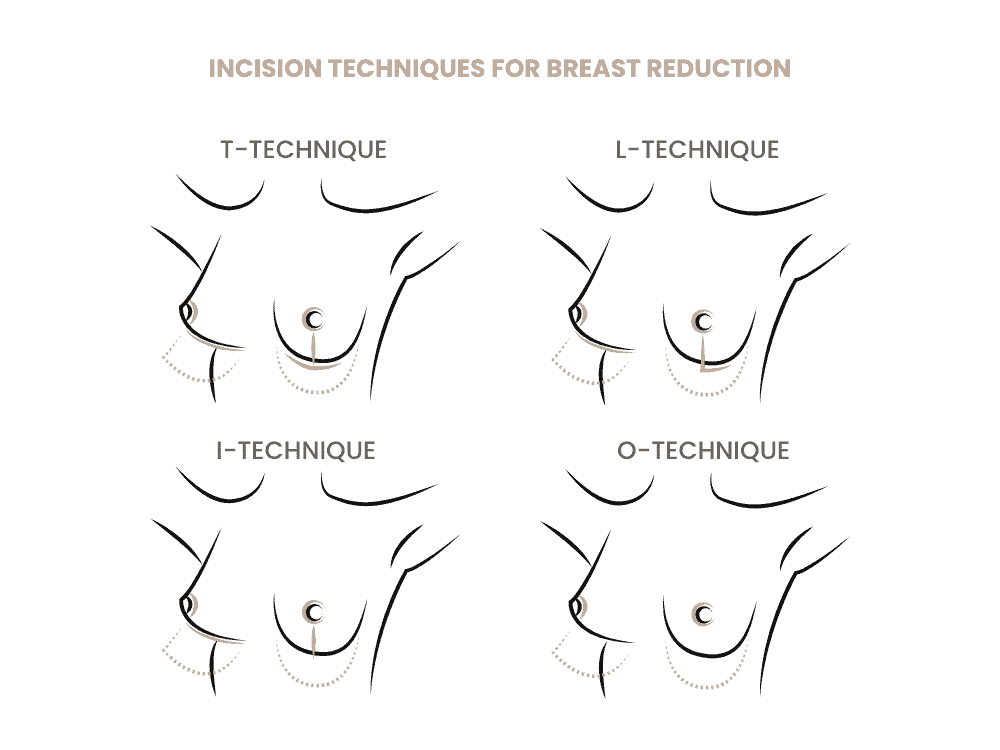
What scar patterns are possible?
The scar pattern can resemble an inverted T (anchor shape), extend from the areola downward and outward, run vertically downward from the areola, or be limited to the areola itself. For shaping the breast, the anchor-shaped scar pattern is the most effective, as it allows the easiest and most aesthetic contouring. Scar-minimizing techniques can be used when less tissue needs to be removed or when the required nipple lift is not particularly long (< 10 cm).
Can the areola be reduced during breast reduction?
Yes, reducing the size of the areola can be done easily during breast reduction and is usually performed routinely at no additional cost.
Can breast reduction be performed under local anesthesia?
No, breast reduction is an extensive procedure and should be performed under general anesthesia.
Does breast reduction affect the ability to breastfeed?
Generally not, though in rare cases breastfeeding ability may be affected. Only when outdated methods (free nipple grafting) are used is the ability to breastfeed completely lost.
Does breast reduction affect nipple sensitivity?
Some techniques carry a lower risk of reducing nipple sensitivity than others, though they may have other disadvantages. If maintaining nipple sensitivity is particularly important, you should inform your surgeon.
What complications can occur?
The most common medical complication is postoperative bleeding, followed by infection and wound-healing problems (necrosis of the skin and/or areola). When performed correctly, these complications are rare. Result-related complications include asymmetry in size or shape, distorted areolas, and widened scars. Aesthetic complications can almost always be fully corrected; unfortunately, this is not always possible with severe medical complications such as necrosis.
How soon can one resume normal activities after breast reduction?
Generally, normal activity can be resumed after 10–14 days.
What are the long-term results after breast reduction?
If weight fluctuations and pregnancies are avoided, long-term results are generally very good. A reduced breast typically maintains its smaller size. The durability of the result, however, varies — how long the new shape lasts and when sagging may recur depends on the weight of the breast (gravity), the individual tissue quality (firm or loose connective tissue), and the surgical technique used.

Contact
Interested in a consultation?
Popular Treatments
Breast augmentation using the patient’s own fat
Gentle breast augmentation using the body's own fat – for a natural shape and harmonious proportions.
Learn moreEyelid Lift in Vienna | Youthful Eyes
A fresher, more alert appearance achieved by removing excess skin from the upper and lower eyelids.
Learn moreFacelift
Facial and neck tightening for a visibly younger, naturally fresh appearance.
Learn moreGynecomastia
Treatment for male breast enlargement to achieve a masculine, flat chest contour and boost self-confidence.
Learn moreRhinoplasty
Aesthetic and functional rhinoplasty for a harmonious facial profile.
Learn more