

Your specialist for
eyelid lifts in Vienna
An eyelid lift (correction of drooping eyelids) makes your eyes look younger and more attractive. In addition to tightening the upper eyelids (drooping eyelids), it is often necessary to perform additional corrections: lifting the (lateral) eyebrows, tightening the lower eyelids, and correcting bags under the eyes, dark circles, and, not infrequently, festoons.

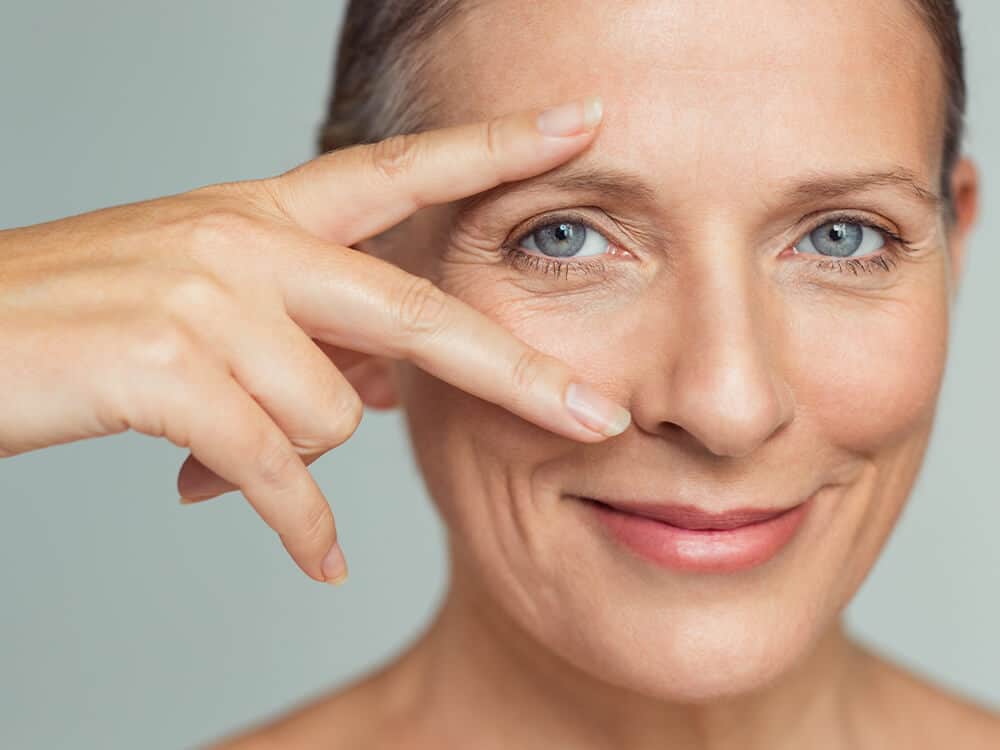


Eyelid surgery: almost always much more than just “correcting droopy eyelids”
The eyes play a central role in human expression—they are said to be the window to the soul. Accordingly, the eyelids and the area immediately surrounding them, such as the eyebrows and the midface, have a significant impact on the overall facial expression.
Many people suffer from drooping eyelids, bags under the eyes, dark circles, or sagging eyebrows, which makes them feel tired or unattractive (“Doctor, people keep asking me why I look so tired…”).
Since 1997, I have specialized in cosmetic eye surgery and have performed approximately 1,500 eyelid procedures. This experience enables me to analyze each problem area in detail and develop a personalized, precise treatment plan—with the goal of achieving an open, natural, and harmonious appearance.

Key points at a glance
The key information you need to quickly determine whether an eyelid lift is right for you.

Effective date
Your eyes will look more open and refreshed. Initial changes are visible quickly; the final result will be apparent once the swelling subsides and the area heals.

Durability
When performed correctly, the results are long-lasting. The aging process continues, but the eye area appears noticeably rejuvenated.

Duration
Depending on the extent of the procedure, it usually takes 1 to 3 hours. Combined procedures (brows, lower eyelids, dark circles/eye bags) take correspondingly longer.

Costs
Upper eyelid lift alone starting at 2,200 euros. Combined procedures range from 4,500 to 10,000 euros, depending on the findings (see the overview below for details).

Check
Several follow-up appointments after surgery. Final follow-up appointment after one year.

First Ordination
The initial consultation is included with the purchase of the book (“Eyelid Correction,” 40 euros). Without the book: 250 euros; detailed consultation: 300 euros (second opinion: 300 euros, creditable toward surgery).







Why get an eyelid lift?
Over the course of a lifetime, changes in the skin cause the eyelids to sag and the eyebrows to droop. Although this is a normal part of the aging process, it significantly alters one’s appearance.
Our eyelids and the area immediately surrounding them (brows, midface) have a significant impact on whether we appear sad, happy, tired, or well-rested. They frame the eyes and play a crucial role in our facial expressions. That is why bags under the eyes (fat deposits under the eyes), drooping eyelids (sagging upper eyelids), or wrinkled lower eyelids often make us look tired and older.
A carefully planned eyelid correction can open up the eyes, harmonize facial contours, and restore a natural, fresh appearance—without altering your individual facial expressions or personality. A key factor in this process is a detailed analysis of all the structures surrounding the eye.
Your benefits at a glance
- A naturally open and alert gaze
- Harmonization of the upper and lower eyelids
- Combined with a brow lift if necessary
- Correction of under-eye bags and dark circles is possible
- Modern techniques for minimizing visible scars
- Customized surgical planning based on a precise analysis
- Many years of specialization and operational experience
- Long-lasting, stable results when performed properly
Eyelid Lift: What You Need to Know!
Correcting the eyelids and the surrounding area is one of the most challenging procedures in aesthetic plastic surgery and is, unfortunately, often underestimated. To help illustrate its complexity, we will first list the specific issues individually, then describe the possible surgical techniques, and finally discuss potential combination procedures.
Anyone considering surgery should, prior to the procedure, clearly identify what is actually bothering them about their eyelids (or the surrounding area) and what needs to be corrected. Together with the consulting physician, they will assess what is realistically possible, and the treatment plan will be finalized jointly.
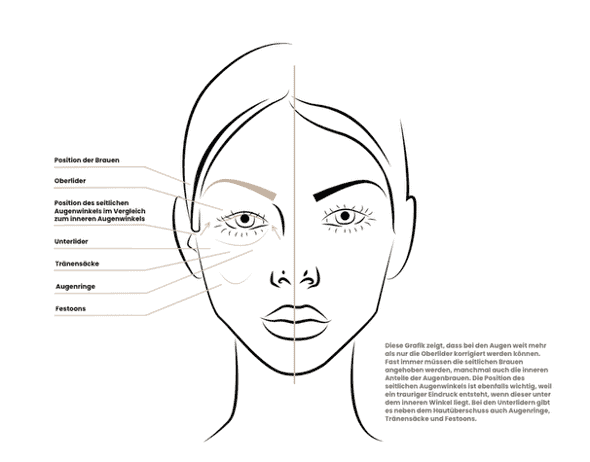
The following aspects should be taken into account when analyzing the eyes: 1. Position of the eyebrows, 2. Upper eyelids, 3. Lower eyelids, 4. Canthal tilt, 5. Bags under the eyes, 6. Dark circles under the eyes, 7. Festoons
Example and Analysis
Operational concept for the example on the right:
Lateral eyebrow lift, removal of excess skin from the upper and lower eyelids, and correction of under-eye bags and dark circles using fat grafting. The procedure is performed under local anesthesia or twilight sedation, lasts approximately 2–2.5 hours, and requires a one-night hospital stay with the eyes bandaged.
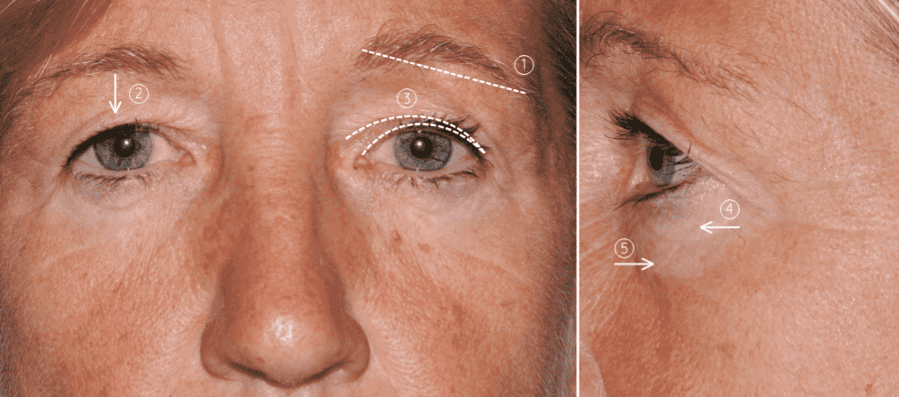
The following aspects should be taken into account when analyzing the eyes: 1. Position of the eyebrows, 2. Upper eyelids, 3. Lower eyelids, 4. Canthal tilt, 5. Bags under the eyes, 6. Dark circles under the eyes, 7. Festoons

Combined procedures
Possible procedures involved in eyelid surgery
- Upper eyelid lift (drooping eyelids).
- Lifting of the outer eyebrows (pseudo-drooping eyelids) without a forehead lift.
- Lifting the outer eyebrows in conjunction with an upper eyelid lift (the most common procedure).
- Lifting the inner eyebrows without a forehead lift.
- Autologous fat into the upper eyelid crease for sunken eyes.
- Correction of under-eye bags (removal or fat pad repositioning—depending on the severity and whether dark circles are also present).
- Correction of dark circles under the eyes using autologous fat grafting
- Surgical correction of under-eye circles using fat repositioning, combined with autologous fat if necessary.
- Lower eyelid lift (a complex procedure, often involving additional measures to prevent ectropion).
- Correction of a negative canthal tilt (“puppy eyes” → “cat eyes”).
- Correction of drooping eyelids (either on its own or in combination with a lower eyelid lift—one of the most challenging procedures in the field of aesthetic eye surgery).
- Brow lift (also known as a forehead lift), when sagging forehead skin is the primary cause of a tired appearance.
- Laser eyelid correction (see separate explanation below).
Causes and Symptoms
Elastin and collagen ensure a firm, even complexion. Over time, the skin loses these proteins, elasticity decreases, and wrinkles form, along with excess skin on the eyelids. The resulting tired or sad appearance is understandably undesirable.
Drooping eyelids do not only occur in older people, but are also quite common in younger individuals (as early as 18–20 years of age). Similarly, dark circles and under-eye bags can be present at a young age. The cause is usually genetic predisposition—neither pathological nor dangerous. With proper diagnosis and realistic expectations, such conditions can, of course, be surgically corrected even at a young age.
Contributing factors: unhealthy diet · smoking · lack of sleep · sun exposure · alcohol · stress
Upper eyelid lifts are almost always performed for cosmetic reasons
Drooping eyelids (blepharochalasis) occur equally in women and men; they are usually bilateral and rarely unilateral. Eyelid surgery (blepharoplasty) is almost always performed for cosmetic reasons. However, in severe cases, it can lead to visual impairments (restricted visual field)—in which case health insurance covers the surgery at a public hospital.
During the procedure, excess skin on the upper eyelid is removed. A symmetrical, natural result is achieved by precisely measuring and marking the excess skin before the surgery. Sometimes, part of the fat pad must also be removed.
There are limits to eyelid lifting. The precise knowledge of how much tightening is “right” to combine rejuvenation with a natural look comes only through years of surgical experience. My tip: During the initial consultation, ask to see many before-and-after photos, assess the naturalness of the results, and have the surgical plan explained to you.
The incision is made so that scars remain as inconspicuous as possible: on the upper eyelid in the crease (usually 7–8 mm) and on the lower eyelid along the lash line. If the procedure is successful, the eyes appear more radiant after surgery, the gaze more open—and the scars are soon barely noticeable.
The eyelids and forehead skin undergo the same aging process. In particular, the eyebrows often droop asymmetrically, primarily on the sides (in about 75–85% of cases). This creates the appearance of drooping eyelids that are more pronounced on the sides (pseudo-ptosis), even though the main cause is the drooping of the lateral eyebrow.
In such cases, a lateral eyebrow lift is often sufficient to reopen the upper eyelid crease.
Eyebrow lift techniques (lateral or full)
Lateral brow lift – three methods:
Removal of a skin flap above the brow (leaves scars, not very effective – I don’t perform this procedure).
Anchoring the lateral eyebrow to the bone (periosteum) – effective, but I prefer the thread method.
Lifting the lateral eyebrow with a thin thread (anchored in the temporal region) – in my view, the method of choice (performed more than 800 times).
If there is also significant excess skin on the upper eyelid, the combination of an upper eyelid lift and a lateral brow lift is often the treatment of choice. This combined procedure is performed on approximately 80% of my patients when upper eyelids are lifted.
Complete brow lift – two methods:
1. Forehead lift (very effective, but a more extensive procedure).
2. Thread lift anchored in the center of the forehead (minimally invasive, but less powerful – suitable for a 8–10 mm lift).
Many people have a very wide upper eyelid crease, which makes their eyes appear “sunken.” This is often perceived as unsightly. In this situation, under no circumstances should more skin be removed—that would only exacerbate the problem.
Instead, volume must be added: the treatment of choice is autologous fat grafting. We always enrich the autologous fat with PRP (platelet-rich plasma) to make it supple and malleable and to increase the healing rate.
Solution: Autologous fat grafting
Laser Eyelid Surgery
In the past, I was often asked why I don’t perform eyelid surgery “with a laser.” The laser simply replaces the scalpel—the surgical principle remains the same. Whether and how much fat is removed or added, and what additional procedures are necessary, is independent of the laser.
In the past, I was often asked why I don’t perform eyelid surgery “with a laser.” The laser simply replaces the scalpel—the surgical principle remains the same. Whether and how much fat is removed or added, and what additional procedures are necessary, is independent of the laser.
Wrinkled Lower Eyelids – How Can Sagging Lower Eyelids Be Corrected?
As we age, the skin of the lower eyelids also loses its elasticity. This leads to wrinkles and a tired appearance. Surgical tightening can significantly smooth the lower eyelid area—but requires the utmost precision to avoid complications.
Lower eyelid tightening is generally a technically feasible procedure: The incision is made just below the eyelashes, the skin is carefully separated from the underlying muscle, the excess skin is precisely assessed and removed, and the incision is closed without tension.
However, the key is to strike the right balance. If too much skin is removed or if excessive scar contraction occurs during healing, downward tension develops along the lower eyelid margin. The lower eyelid may turn outward and no longer fit snugly against the eyeball.
This complication is called ectropion.
Ectropion poses both aesthetic and functional problems. Correcting it is technically challenging and does not always result in complete success.
For this reason, every lower eyelid lift must be performed by a highly experienced surgeon, with precise planning and—if necessary—additional stabilizing measures to consistently minimize this risk.
Eyelid Surgery Overview
Preventing ectropion is the key factor in any lower eyelid lift. Even before the operation, the elasticity and stability of the lower eyelid must be carefully assessed. Depending on the findings, additional stabilizing measures may be necessary.
The Snap Test
To assess lower eyelid elasticity, the so-called snap test is performed:
In this test, the lower eyelid is gently pulled away from the eyeball, and the speed at which it returns to its original position is observed.
- Quick rebound → low risk
- Delayed response (> 0.5–1 second) → increased caution
If reduced elasticity is observed, additional measures must be planned during lower eyelid lift surgery to prevent the lower eyelid from turning outward (ectropion) later on.
Canthopexy (additional stabilizing measures)
The outer corner of the eye is gently lifted and secured to the bone (periosteum) of the upper eye socket.
This stabilizes the lower eyelid without significantly altering its natural position.
(Important: This differs from canthoplasty, in which the position of the eyelid is intentionally altered.)
SMAS reinforcement (additional stabilizing measures)
The superficial muscular layer (SMAS) is elevated and secured laterally.
This significantly reduces the tension on the lower eyelid.
Mini Midface Lift (Additional Stabilizing Procedures)
In the zygomatic region, the tissue is lifted upward and secured.
In addition to stabilizing the lower eyelid, this procedure often also reduces the appearance of the nasolabial fold.
Muscle sling
The lateral fibers of the lower eyelid muscle are guided upward and secured. This creates a supportive “hammock-like” structure for the lower eyelid.
Other eye treatments
Eyelid Surgery: Correcting Drooping Eyelids

Get rid of under-eye bags
Here’s how your treatment works
-
01
First ordination
Have you already purchased the book “Eyelid Correction” for 40 euros at our office or online? If so, the initial consultation for your surgery is included. An initial consultation typically lasts about 30 minutes. Without purchasing the book, the fee is 250 euros; any longer or more detailed initial consultation is charged at 300 euros. I also charge 300 euros for a second opinion after surgery has already been performed; this amount will be credited toward a revision surgery. My tip: Always get a second opinion before undergoing a procedure (not included with the book purchase).
-
02
Hospital stay (optional)
This is rarely necessary—the procedure is typically performed on an outpatient basis at my surgical center. If an inpatient stay is required (with an overnight stay): 1,800 to 4,500 euros, depending on the duration of the procedure, the number of nights, the room category, and the hospital.
-
03
Before the procedure
You can find all the information you need about pre-surgery examinations, as well as a checklist for planning your appointment, hospital stay, and follow-up visits, here:
-
04
Anesthesia and the procedure
Usually twilight sedation (sedation with analgesia); for combined procedures, general anesthesia may be used. Costs range from 400 to 1,600 euros, depending on the duration; the average is 600–800 euros.
-
05
Visits & Inspections
Check-ups and visits are included in the fee.
Costs
How much does an eyelid lift cost in Vienna?
Depending on the type of breast lift, the surgical fee ranges from €2,200 to €10,500.
Before-and-after comparison
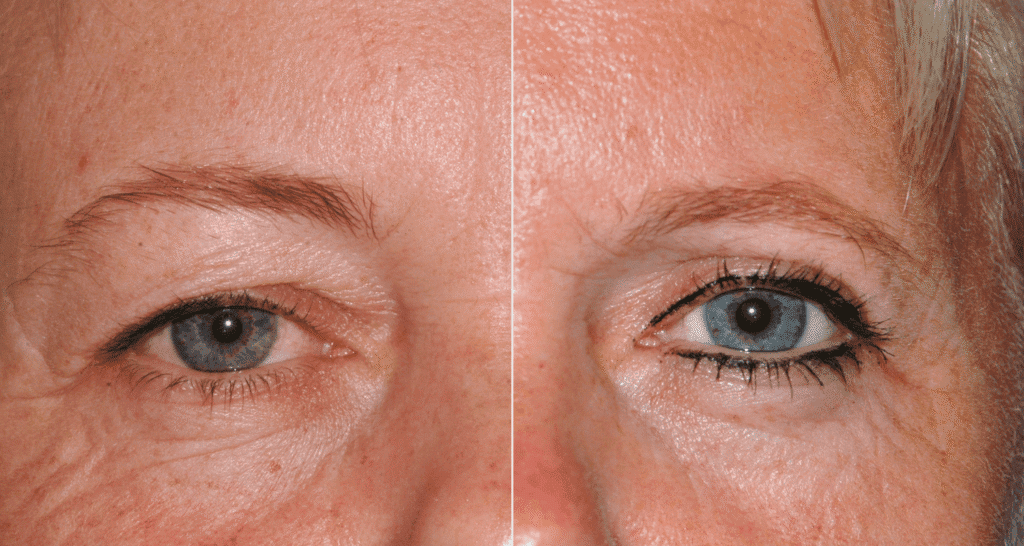
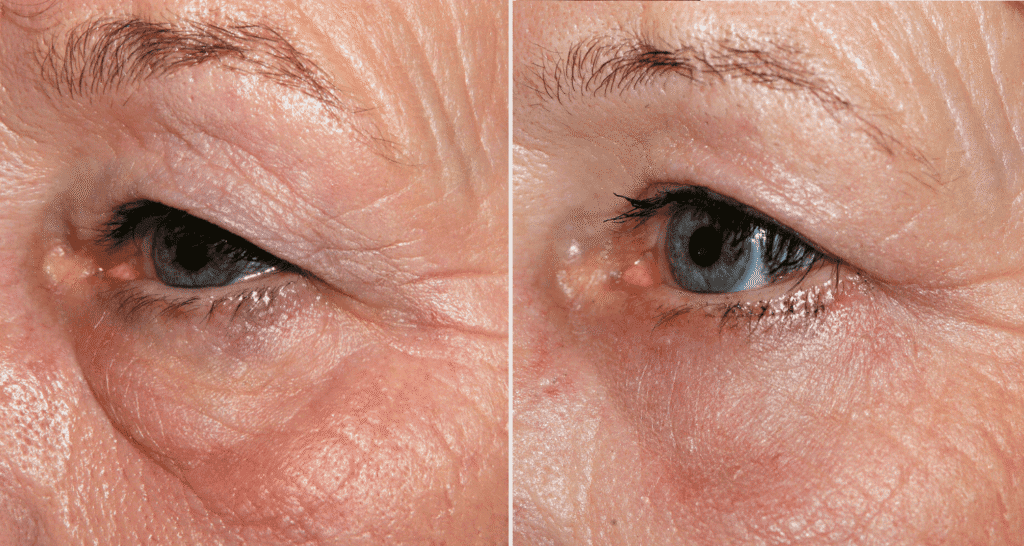
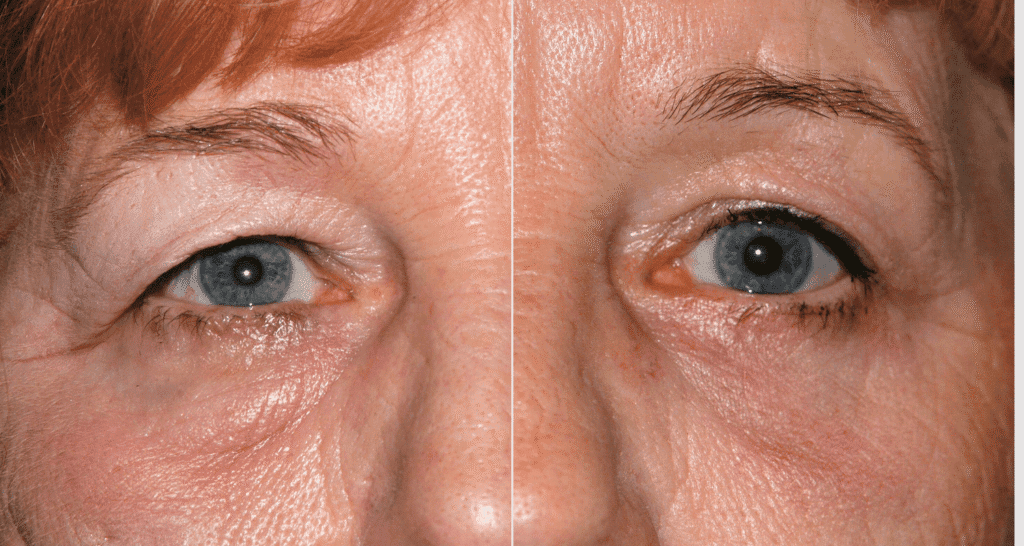
We will show you examples of procedures that are almost always combined: upper eyelid lifts with brow lifts, bag-under-the-eye and dark-circle corrections—often combined with lower eyelid lifts—corrections of festoons, mini-midface lifts, and combinations of these. These are particularly challenging procedures—especially lower eyelid lifts.
Reviews
What our patients say

Dr. Turkof made my lips more beautiful and symmetrical.
He looked from every angle and only injected the filler where I really needed it. I look natural — if it were possible, I would get more injected.
I know Dr. Turkof through a friend who came all the way from Germany specifically for him. She was very happy with him and recommended him to me, as I was really struggling with dark under-eye circles. My surgery was 3 months ago and I am very pleased with the natural result.
I had two operations with autologous fat transfer to the breast and ribs with Prof. Turkof.
The result is fantastic and I am very satisfied. The quality of Prof. Turkof as a plastic surgeon is, from my perspective, undisputed.
Frequently Asked Questions
Here you will find answers to the most frequently asked questions about the procedure and how to prepare for eyelid surgery.
What are under-eye bags?
Eye bags are a visible bulge under the eye caused by protruding fat deposits due to weakened connective tissue.
What are dark circles under the eyes?
Most often, this refers to the typical indentation in the tissue beneath the lower eyelid along the bony rim; when the discoloration is purely dark, it is referred to as dark circles under the eyes.
What are drooping eyelids?
Drooping upper eyelids with excess skin, often giving a tired or sad appearance; this can also occur on one side only.
What should you keep in mind after an eyelid lift?
Avoid strenuous activity for the first few days; wear sun protection (sunglasses). You can usually resume exercise about a week after the stitches are removed, and makeup is often possible starting on day 10.
When should the eyebrows be included?
When there is excess skin on the sides of the face, the lateral eyebrow is often drooping (very common). In such cases, a lateral brow lift should be included in the treatment plan.
Can all problem areas be corrected at the same time?
Generally speaking, yes. For combined procedures, the surgery takes about 2.5 to 3 hours; a bandage is usually left in place for one night afterward.
What does an upper eyelid correction involve?
Removal of excess skin; some fat or muscle may also be removed. Often combined with a lateral brow lift.
How are lower eyelids corrected?
Proceed with caution to avoid ectropion; if necessary, perform additional canthopexy or take other measures to stabilize the eyelid.
How are under-eye bags treated when dark circles are also present?
Most commonly, fat grafting (where fat is used to fill in under-eye circles), often supplemented with the patient’s own fat.
What is ectropion?
Eversion of the lower eyelid, causing it to protrude outward. This condition may be age-related or result from a complication and can be corrected surgically.
What complications can occur?
Overcorrections (e.g., too much skin) can cause problems; additional risks include tearing, hypersensitivity, and asymmetry. Corrections are usually possible.
Will my eyes look different after an eyelid lift?
The shape of the eyes doesn’t change “fundamentally”—they just look fresher, more open, and more rested.
When will I be socially acceptable again?
Depending on the procedure, usually after 10–14 days.
Do you have any questions?
Personal consultation
Do you have any further questions or would you like some general information? We offer personalized, comprehensive advice, drawing on our experience since 1997.
You can schedule your appointment online at any time.
Our most popular treatments
Breast augmentation using the patient’s own fat
Gentle breast augmentation using the body's own fat – for a natural shape and harmonious proportions.
Learn moreEyelid Lift in Vienna | Youthful Eyes
A fresher, more alert appearance achieved by removing excess skin from the upper and lower eyelids.
Learn moreFacelift
Facial and neck tightening for a visibly younger, naturally fresh appearance.
Learn moreGynecomastia
Treatment for male breast enlargement to achieve a masculine, flat chest contour and boost self-confidence.
Learn moreRhinoplasty
Aesthetic and functional rhinoplasty for a harmonious facial profile.
Learn more