

PRP
Non-Surgical Aesthetics
Platelet-rich plasma (abbreviated as PRP) refers to blood plasma that has been processed by humans to contain a significantly higher concentration of platelets than normal blood—two, three, or even more times concentrated. Blood plasma (plasma) is the liquid component of blood, meaning the fluid portion without blood cells.




There are three types of cells in the blood:
- Red blood cells (or erythrocytes): responsible for transporting oxygen.
- White blood cells (leukocytes): responsible for immune defense and protection against infections.
- Platelets (thrombocytes): responsible for blood clotting and, subsequently, for the repair (healing) of injured tissue.
Here, we focus on the platelets. They are much smaller than red and white blood cells. Their typical concentration is 150,000 to 300,000 per microliter of blood.
Their function can be briefly described as follows: when an injury occurs, platelets form a clot, which—together with the clotting factors in the blood—seals the damaged vessel.
Once the bleeding is stopped, the membranes of the platelets rupture and release their contents: hundreds of different growth factors.
These valuable and beneficial proteins have the ability to restore damaged tissue and initiate the healing process.
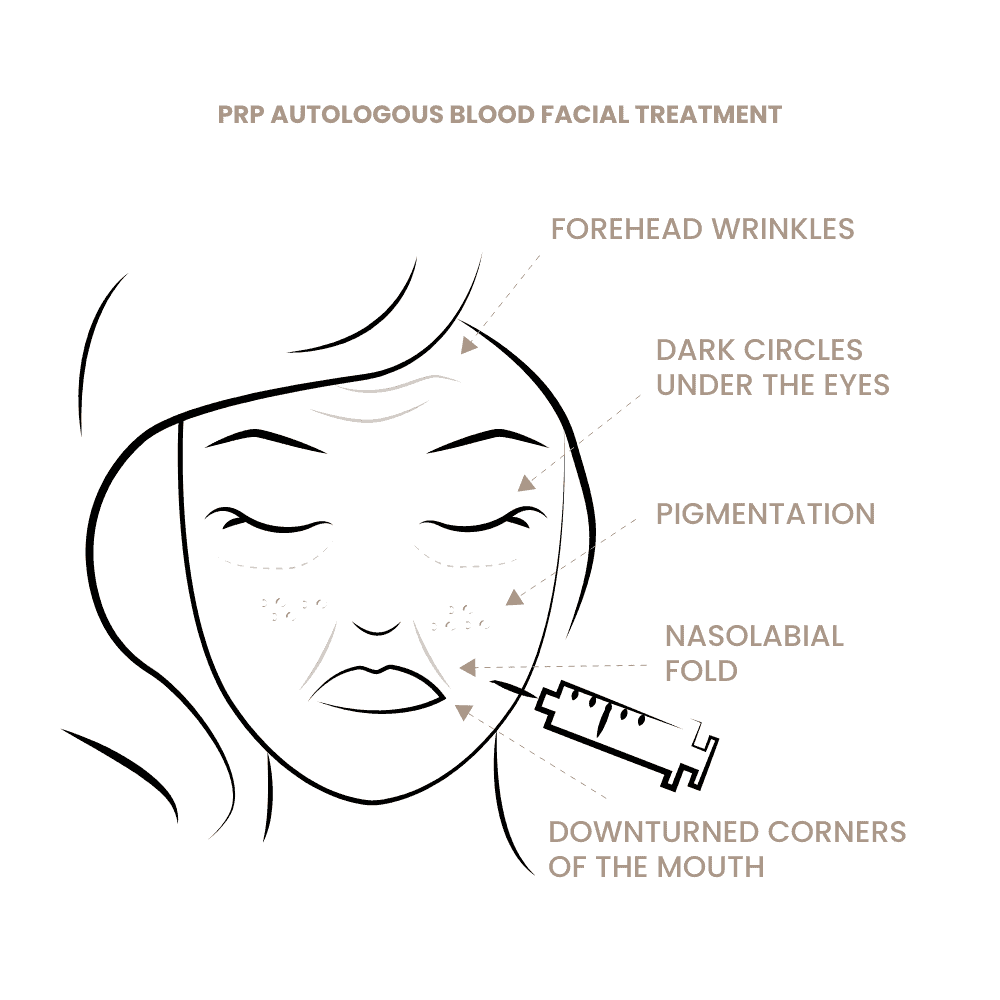
Why and for what purpose is PRP produced?
In 1970, it was first described that platelets could be easily concentrated and that this concentrate could be used medically to support healing. As with a standard blood draw, 10–40 ml of blood is taken, depending on the need, filled into a test tube that contains an anticoagulant (CaCl), and then centrifuged. Since the different components of blood (cells, plasma) have varying specific weights, several layers form in the tube.
At the bottom lie the red blood cells, which make up the majority of the cellular volume. Above that is a thin layer of white blood cells (known as the “buffy coat” in English), which is barely visible to the naked eye. Above this, the yellowish fluid layer—the blood plasma—is visible. At the bottom of this plasma layer are the concentrated platelets, which cannot be seen without a microscope. If this bottom part of the plasma is extracted, it results in platelet-rich plasma (PRP)—a fluid in which the platelet concentration is significantly higher than in regular blood.
In the upper part of the centrifuged tube, there are far fewer platelets—this part is referred to as PPP, short for “platelet-poor plasma,” although this term is rarely used in German-speaking contexts.
Images and illustrations
As a general rule: one-fifth of the drawn blood volume can be used as PRP. So, if 10 ml of PRP is needed, 50 ml of blood must be drawn. This also defines the practical limit of PRP therapy: in a person of average size and weight, around 150 ml of blood can be taken without causing circulatory problems or discomfort. Therefore, 30 to a maximum of 40 ml of PRP can be obtained per treatment.
For most treatments, much smaller amounts are sufficient (on average 20–40 ml), meaning the vast majority of known applications are easily feasible.
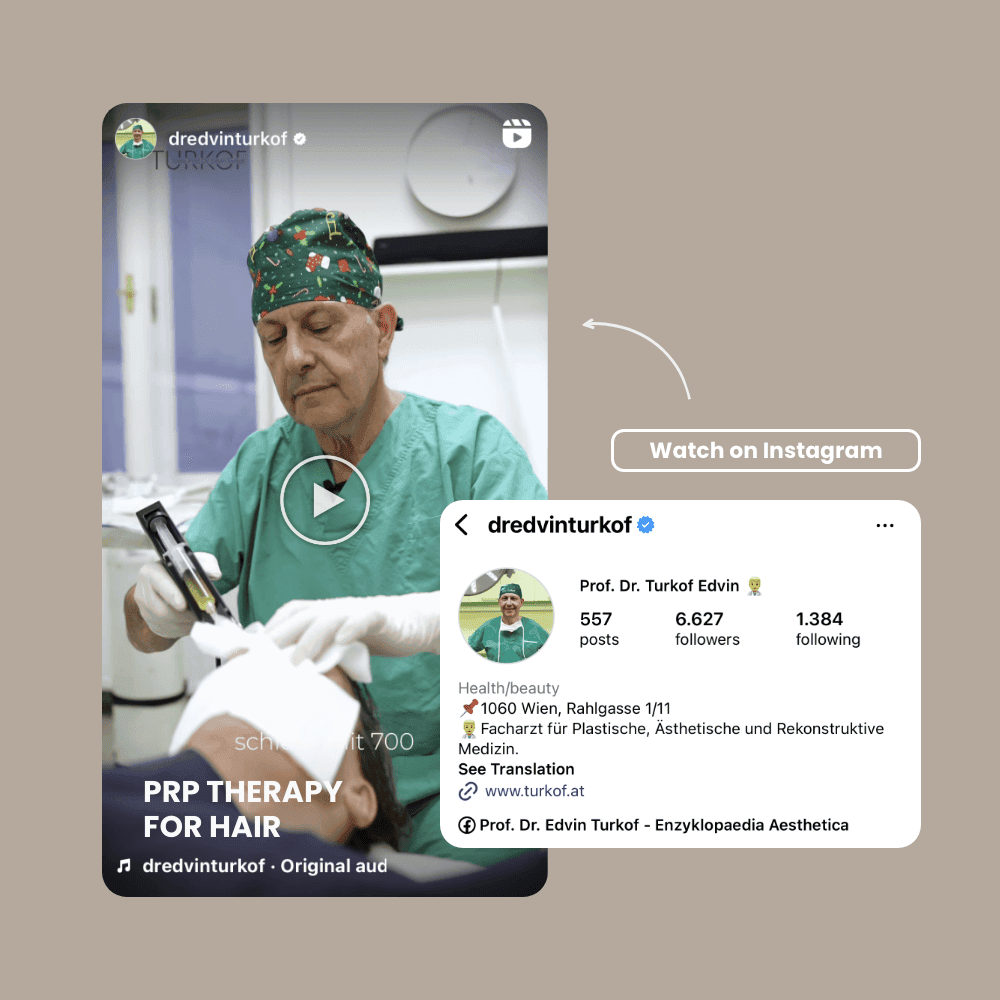
Production of PRP / Industry / Quality Control
As mentioned at the beginning, PRP is produced by drawing blood and centrifuging it. To simplify this process for treating physicians, the medical industry has developed kits (commercially available sets containing the necessary components for PRP production, except for the centrifuge). There are around 50 such kits on the market. Of course, a centrifuge must also be purchased. It usually comes with fixed settings, meaning the speed and duration of centrifugation are predetermined and cannot (or should not) be changed.
The kits include needles, syringes, and filtration systems that process the drawn blood by separating its components during centrifugation in such a way that the physician receives ready-to-use PRP in a syringe. This process is standardized.
However, it has become clear that due to the individual cellular and physical properties of blood, PRP is not always reliably produced. In other words: if you always do the same thing—i.e., centrifuge all blood the same way—you won’t always get PRP. Sometimes, the platelet concentration in the plasma is only equal to, or even lower than, that in normal blood.
Recent publications show that PRP is achieved in only about 65–70% of cases. In 10–15%, the concentration is roughly equivalent to that of whole blood, and in another 10–15%, the concentration is actually lower than that of normal blood.
This highlights the importance of verifying the outcome of PRP preparation before administering it to patients—because true PRP only results in about two-thirds of routine preparations.
Such verification is not complicated: there are small laboratory devices that can measure the platelet concentration in a plasma sample in under two minutes. If the concentration is adequate, treatment proceeds. If the platelet count is too low, re-centrifugation can increase the concentration.
For patients and consumers, this is important to understand: You should only agree to a PRP treatment if the platelet concentration is checked by the provider beforehand.
Applications of PRP
Below is an overview of the many possible applications of PRP.
Summary
The possible applications of PRP are indeed diverse. They overlap considerably with those of nanofat treatment. However, nanofat is significantly more effective, although it involves a much more complex and time-consuming process.







Reviews
What our patients say

Dr. Turkof made my lips more beautiful and symmetrical.
He looked from every angle and only injected the filler where I really needed it. I look natural — if it were possible, I would get more injected.
I know Dr. Turkof through a friend who came all the way from Germany specifically for him. She was very happy with him and recommended him to me, as I was really struggling with dark under-eye circles. My surgery was 3 months ago and I am very pleased with the natural result.
I had two operations with autologous fat transfer to the breast and ribs with Prof. Turkof.
The result is fantastic and I am very satisfied. The quality of Prof. Turkof as a plastic surgeon is, from my perspective, undisputed.

Contact
Interested in a consultation?
Popular Treatments
Breast augmentation using the patient’s own fat
Gentle breast augmentation using the body's own fat – for a natural shape and harmonious proportions.
Learn moreEyelid lift
A fresher, more alert appearance achieved by removing excess skin from the upper and lower eyelids.
Learn moreFacelift
Facial and neck tightening for a visibly younger, naturally fresh appearance.
Learn moreGynecomastia
Treatment for male breast enlargement to achieve a masculine, flat chest contour and boost self-confidence.
Learn moreRhinoplasty
Aesthetic and functional rhinoplasty for a harmonious facial profile.
Learn more