
Rhinoplasty
Face
The nose is the focal point of the face – even minor irregularities can affect its overall harmony.
A rhinoplasty eliminates bothersome features and restores balance to your proportions – naturally, functionally, and with a personalized approach.




Your specialist for rhinoplasty in Vienna
Aesthetic rhinoplasty is considered the most demanding procedure in aesthetic surgery. Bone, cartilage, skin, and mucous membrane form a complex interplay – which must remain fully functional even after the operation.
Therefore:
– Consider aesthetics and breathing equally
– Stability is more important than radical removal
– Experience determines the outcome
Since 1997, facelifts have been one of my surgical specialties. With over 1,000 procedures performed, every treatment plan is based on experience, precision, and a clear objective: visible rejuvenation with maximum naturalness.

The most important information at a glance
The most important information to help you quickly assess whether a rhinoplasty is right for you.

Effective date
Changes are immediately visible. The final result becomes apparent after the swelling subsides – usually after 3–12 months.

Durability
The result is usually permanent, as bone and cartilage structures are stably reshaped.

Duration
Depending on the complexity, 1.5–3 hours. Complex reconstructions may take longer.

Costs
Depending on the technique and initial findings, between €3,500 and €12,000.

Check
Several follow-up appointments after the surgery. Final check-up after 1 year.

First Ordination
Included with book purchase. Without book: €250–300.







Why a nose job?
The decision to have a rhinoplasty is not a spontaneous one. Nor is it an easy decision. And it shouldn’t be. On the contrary: often, the feeling lingers for years that something about one’s face isn’t quite right. The nose becomes the focal point – in the mirror, in photos, in profile.
Some find them too dominant, others crooked, too long, or too wide. Still others suffer from functional breathing difficulties. What unites them all is the desire for more harmony and inner peace in their own appearance.
A rhinoplasty can help make the face appear more balanced overall. Not noticeably altered, but naturally fitting. The goal is not a new face, but a feeling of harmony – and often, with it, a new level of self-confidence.

Your advantages at a glance
- Naturally harmonious result: Your nose looks balanced and suits your facial features without looking surgically altered.
- Preservation of respiratory function: Aesthetics and function are given equal consideration.
- Stabilization instead of destruction: Modern cartilage techniques ensure long-term shape and stability.
- Individualized surgical planning: Digital simulation realistically shows what is possible and makes sense.
- Correction of complex findings: humps, crookedness, wide nose or nasal tip are precisely adjusted.
- Functional improvement possible: A deviated nasal septum can be corrected at the same time.
- Long-term stable result: The newly formed structures remain permanently intact.
- Specialized experience: Focus since 1997 with high expertise in nasal surgery.
Natural. Harmonious. Individual.
Rhinoplasty
A rhinoplasty improves the proportions of your face and balances your features – without changing your personality.
The procedure is individually planned and takes into account both the aesthetic shape and functional breathing. The goal is a natural-looking result that doesn’t appear surgical.
Important anatomical areas
- nasal bone
- Nasal cartilage
- tip of the nose
- Nasal septum
- nostrils
- bridge of nose
Only when all structures are in balance does a harmonious overall picture emerge.
Four different types of fabric
Bones, cartilage, skin, mucous membrane – a nose is truly complex. Yet it can contribute to a face’s striking beauty!
But be warned: Rhinoplasty is the most difficult procedure in cosmetic surgery and has the longest learning curve of all cosmetic surgical operations. Therefore, only have your rhinoplasty performed by experienced and competent surgeons!
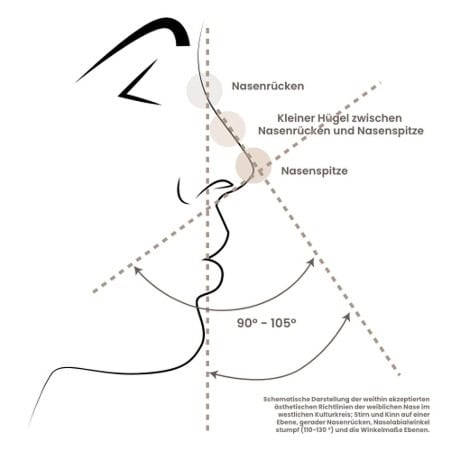
Important information and facts about rhinoplasty
Rhinoplasty can produce a wide variety of changes. In the vast majority of cases, it is possible to meet the wishes of the patients seeking advice, provided that a natural result is desired and the correction addresses congenital or acquired (accident-related) undesirable deformities.
Sometimes people seeking advice want to have an actor’s nose. While I fully understand that people are dissatisfied with their appearance and want to have corrections made, such requests are not feasible.
As a plastic surgeon with many years of experience in the field of aesthetic surgery, I know the limits that nature places on my craft. Furthermore, expectations regarding such requests are unrealistic. After all, my primary goal is to achieve harmony, not to effect a fundamental change.
The nose is made up of various types of tissue, which should still be able to function properly after the procedure. Only in this way is effortless breathing still possible, and only in this way can negative consequences for the respiratory system be prevented.
Therefore, I will provide you with comprehensive consultation before any procedure, including an examination of your breathing function and nasal septum. Using computer simulation, I will show you the possibilities for correcting bothersome anatomical features of your nose while preserving its natural functions. This is the task of a reputable plastic surgeon.
Do you have any questions? Contact me, I’ll be happy to answer them!
Book appointmentThe corrections must not destroy the cartilage.
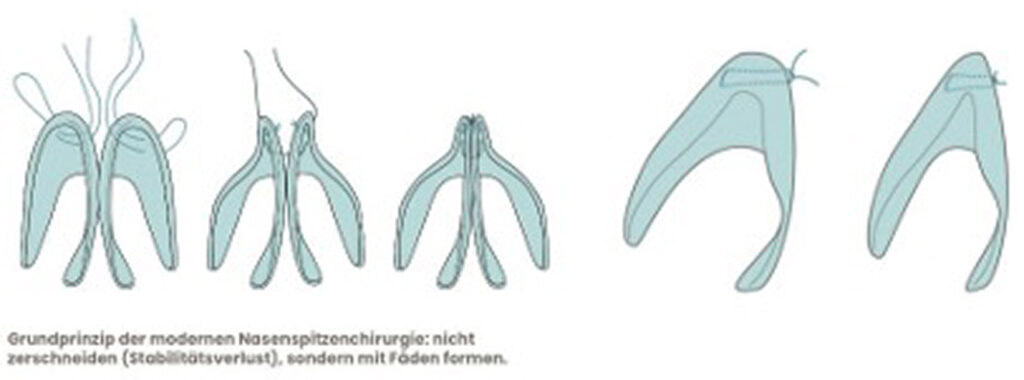
Rhinoplasty used to routinely involve the partial removal and cutting of cartilage. This is no longer the case. Better results are achieved when as much of the cartilage skeleton as possible is preserved. The shape of the nose is corrected using sutures and stabilizing cartilage grafts. Instead of destroying the existing cartilage, the focus today is on stabilizing it. These stabilizing inserts made of cartilage tissue are called struts.
Techniques: Even when discussing a less invasive approach, surgical access is still necessary. This can be closed, semi-open, or open. I wouldn’t prefer one method over the other two, as the advantages and disadvantages of each method depend on the individual situation. One must be proficient in all three methods to achieve the best possible result with the least possible effort, depending on the specific requirements.
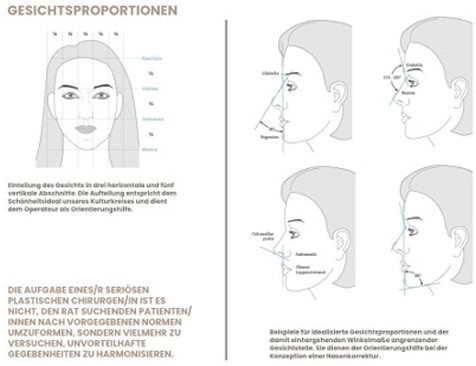
What is corrected most often?
Every rhinoplasty is different. It begins with an anatomical peculiarity that doesn’t fit the overall appearance and disrupts the harmony of the face. The end result is a harmonious appearance. But what happens in between?
There are almost endless possibilities for what can happen during a rhinoplasty; the most common corrections include:
- Removal of nasal humps
– Straightening of the nasal bone in cases of a crooked nose
-Straightening of a deviated septum
– Placement of cartilage grafts in cases of a disproportionately small/short nose
– Reduction of the nasal tip
– Lifting of the nasal tip
– Shortening of the projection (distance from tip to upper lip)
– Lifting of the nasal tip
– Shortening of the projection (distance from tip to upper lip)
– Correction of nasal deformities due to cleft lip, jaw, or palate
The most important (more difficult) problems of rhinoplasty
A bump on the bridge of the nose is particularly noticeable in profile. During the correction, the bump is precisely removed.
Stability is crucial: Beyond a certain size, the removal process creates an opening in the nasal roof (“open roof”). Without stabilization, the middle third of the nose could collapse.
Therefore, shape-stabilizing cartilage grafts (spreader grafts) are used. They secure the nasal structure in the long term and prevent visible indentations.
If the nose appears too wide from the front or the nostrils seem too flared, the base of the nose can be narrowed. This involves positioning the nostrils closer together.
The actual shape of the nose is retained – only the width is harmoniously adjusted.
If the nose appears too long in proportion to the face, this is usually due to the length of the bridge of the nose or the angle between the nose and upper lip (nasolabial angle).
The proportions can be corrected by selectively shortening the bridge of the nose. The goal is a balanced angle that creates neither a droopy nose nor an excessively upturned “snub nose.”
The tip of the nose is particularly sensitive and, as the most challenging part of rhinoplasty, places high demands on the surgeon. Ideally, the tip forms the highest point of the nasal bridge. It should have two symmetrical vertices that refract light. To shape the nasal tip, I use precise sutures and, if necessary, insert cartilage grafts.
The goal: Harmony
The face is our facade, our calling card. That’s why facial harmony is so important. Besides the nose, the chin plays a crucial role. If the chin protrudes or recedes, it disrupts the harmony: Faces are perceived as beautiful when the front point of the forehead and the chin are on the same plane. Therefore, a rhinoplasty isn’t always the only solution. Or to put it another way: The result of a nose job is only truly satisfactory if the chin is also in harmony. And this can often be achieved with a minor additional surgical procedure, such as chin correction. This is because the differences (deficiency or excess) are usually so small that no jaw surgery is required.
Intrigued? Contact our practice. We always take the time for a thorough consultation and precise planning. This includes taking a digital photograph of your nose. Using a morphing program, we can visualize the possible changes and show you the potential results. In this way, we almost always manage to harmonize your wishes with what is surgically feasible and medically advisable. I look forward to meeting you! Simply schedule an appointment.
Cost
How much does a rhinoplasty cost in Vienna?
Depending on the complexity of the procedure and the method used, the surgical fee ranges from €3,500 to €12,000. On average, one should expect to pay between €5,000 and €6,000.
Before/After comparison
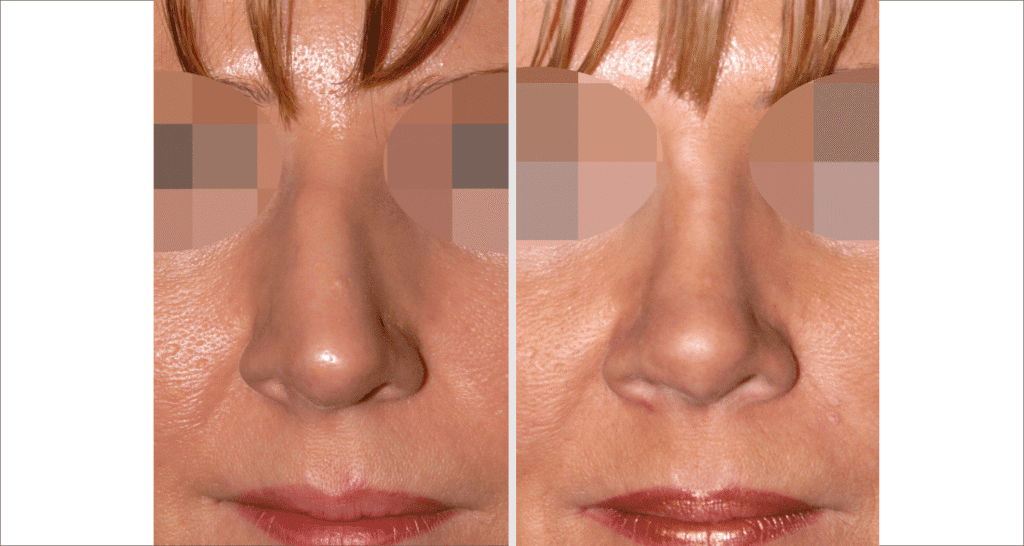
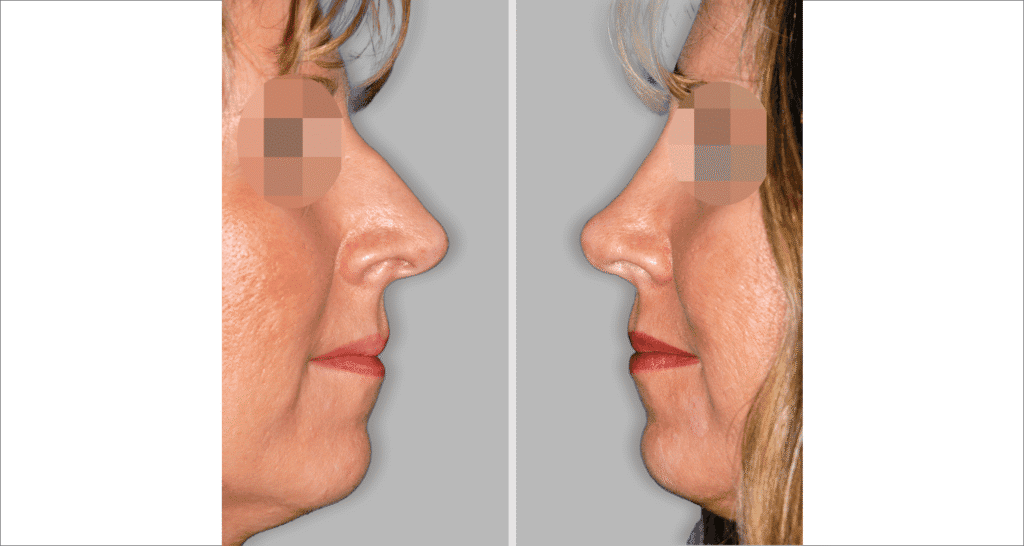
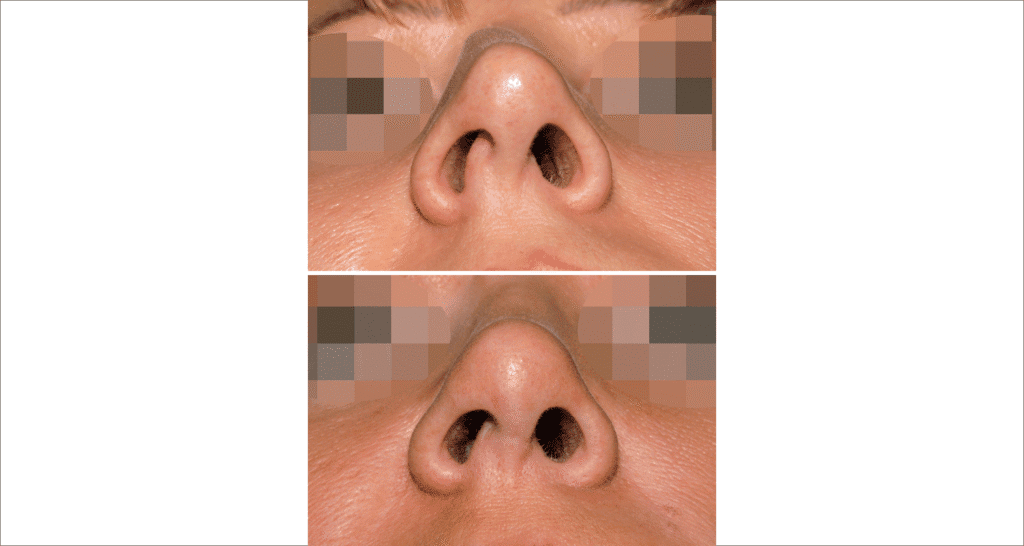
Reviews
What our patients say

Dr. Turkof made my lips more beautiful and symmetrical.
He looked from every angle and only injected the filler where I really needed it. I look natural — if it were possible, I would get more injected.
I know Dr. Turkof through a friend who came all the way from Germany specifically for him. She was very happy with him and recommended him to me, as I was really struggling with dark under-eye circles. My surgery was 3 months ago and I am very pleased with the natural result.
I had two operations with autologous fat transfer to the breast and ribs with Prof. Turkof.
The result is fantastic and I am very satisfied. The quality of Prof. Turkof as a plastic surgeon is, from my perspective, undisputed.
Häufig gestellte Fragen
Below are the most frequently asked questions related to rhinoplasty.
At what age can a rhinoplasty be performed?
The growth of the facial skeleton is usually complete by the age of 18; before this age, rhinoplasty should be avoided if possible.
What can be corrected on a nose?
Many things can be corrected on a nose. The most common corrections involve the hump, the tip of the nose, and the length of the nose. Other corrections concern the saddle, the projection, the shape of the bridge of the nose, the root of the nose, the size of the nostrils, the nasolabial angle, the length of the base of the nose, and much more.
How is the operation ideally planned?
Planning a rhinoplasty consists of two stages. First, the patient’s wishes are recorded, and then the intended changes are simulated using a computer program. This allows the surgeon to assess whether the patient’s expectations are medically sound and aesthetically pleasing. Often, after the simulation, the patient realizes that the desired nose would not suit their face and opts for a different change, developed in collaboration with the surgeon.
Are there medical reasons for a rhinoplasty?
Congenital or accident-related nasal deformities constitute a medical indication for correction. The same applies to all congenital and acquired changes to the nose that impair nasal breathing.
Will the health insurance cover the costs of the procedure?
If there is a medical indication, the health insurance company will cover the costs of the procedure.
What surgical methods are available?
There are three surgical approaches: closed, semi-open, and open. Each method has its indications as well as specific advantages and disadvantages. Therefore, every rhinoplasty surgeon should be proficient in all three methods.
Where do the scars run after a rhinoplasty?
In the closed and semi-open methods, the scars lie within the mucous membranes inside the nose. With the open method, a barely visible scar, 2-3 mm long, remains halfway up the bridge of the nose.
Is the procedure always performed under general anesthesia?
If the procedure is limited to correcting soft tissue, it can be performed under local anesthesia. However, if the bone is also involved, general anesthesia is required.
What complications can occur?
Medical complications primarily include post-operative bleeding and breathing difficulties. However, complications affecting the outcome are far more common and can be numerous: excessively or insufficiently removed hump, crooked nasal walls, an unbalanced nasal bridge, an overly large nasal tip, and much more. Reconstructive procedures following unsuccessful rhinoplasty are often possible but require extensive experience in the field of aesthetic nasal surgery.
How long do you have to stay in the hospital?
Depending on the extent of the procedure, a hospital stay of one to two nights is to be expected.
When can one resume social activities after a rhinoplasty?
Depending on the extent of the procedure, the traces of the operation (swelling, bruising, etc.) will have subsided approximately 2 weeks after the operation.
What influence does the length of the chin have on the appearance of the nose?
The length of the chin plays a crucial role in the overall harmony of the face. Ideally, the foremost point of the forehead and the chin should form a single plane. Deviations can often be corrected without extensive jaw surgery.
Do you have any questions?
Personal consultation
Do you have any further questions or would you like some general information? We offer personalized, comprehensive advice, drawing on our experience since 1997.
You can schedule your appointment online at any time.
Our most popular treatments
Breast augmentation using the patient’s own fat
Gentle breast augmentation using the body's own fat – for a natural shape and harmonious proportions.
Learn moreEyelid lift
A fresher, more alert appearance achieved by removing excess skin from the upper and lower eyelids.
Learn moreFacelift
Facial and neck tightening for a visibly younger, naturally fresh appearance.
Learn moreGynecomastia
Treatment for male breast enlargement to achieve a masculine, flat chest contour and boost self-confidence.
Learn moreRhinoplasty
Aesthetic and functional rhinoplasty for a harmonious facial profile.
Learn more