

Labia Correction
The desire for correction of the inner labia has increased significantly since the year 2000. This is partly due to the renewed popularity of intimate shaving among women in the Western world and partly because aesthetic surgery has become much less of a taboo over the past 25 years.




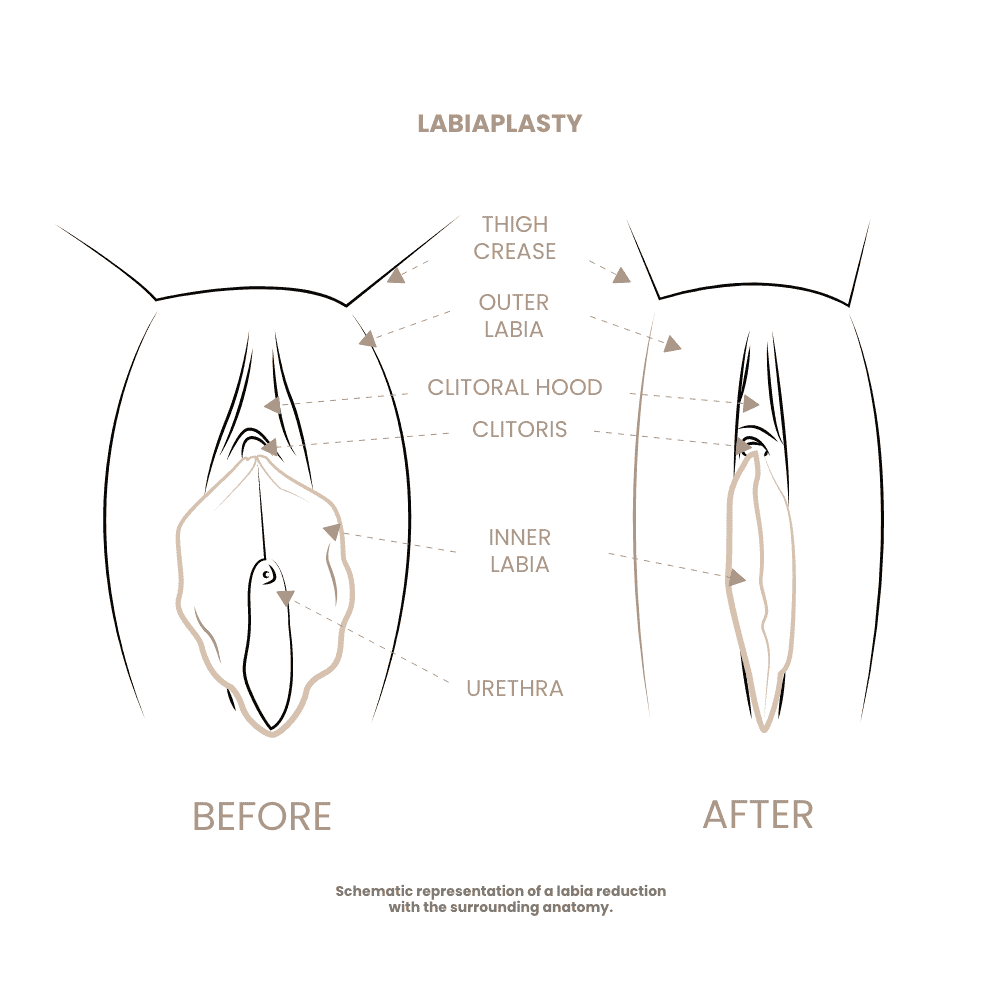
Useful information on the topic of labia correction (labiaplasty)
Overly large inner labia can sometimes lead to physical discomfort. In a study by Gress (2007), 23% of women reported functional reasons—such as pain or chafing when wearing tight clothing, during sports or cycling, and invagination of the inner labia during intercourse—as decisive factors for undergoing labia correction.
Regardless of whether aesthetic or functional reasons are the primary concern, nearly all of my patients wish for their inner labia to be not visible and of equal size when standing upright and exposed. To achieve this, the inner labia usually need to be reduced or adjusted for symmetry. However, there are also cases where the inner labia are not particularly large but still noticeably protrude. This is typically due to the outer labia being very flat and thus covering the vaginal opening (vulva) less than usual.
Intimate shaving reveals the anatomical details of the female genitalia, which shows the same variety as many other bodily features. With increased visibility of the genitals, their external appearance has also gained importance.
A precise analysis is essential for a successful correction.
When assessing the issue, the following aspects must be prioritized: Are the outer labia too small, are the inner labia too large, or is it a combination of both?
Enlarged inner labia can be symmetrized or reduced according to the patient’s wishes. If, in addition to correcting the inner labia, there is also a desire to better cover the vaginal opening, the outer labia can be enlarged using autologous fat (fat grafting), which results in the small labia being (more) covered.
Although labia correction essentially involves the removal of excess skin, this procedure should not be underestimated. The amount of skin to be removed must be precisely marked while checking skin tension, as the high elasticity of the inner labia makes asymmetry especially likely.
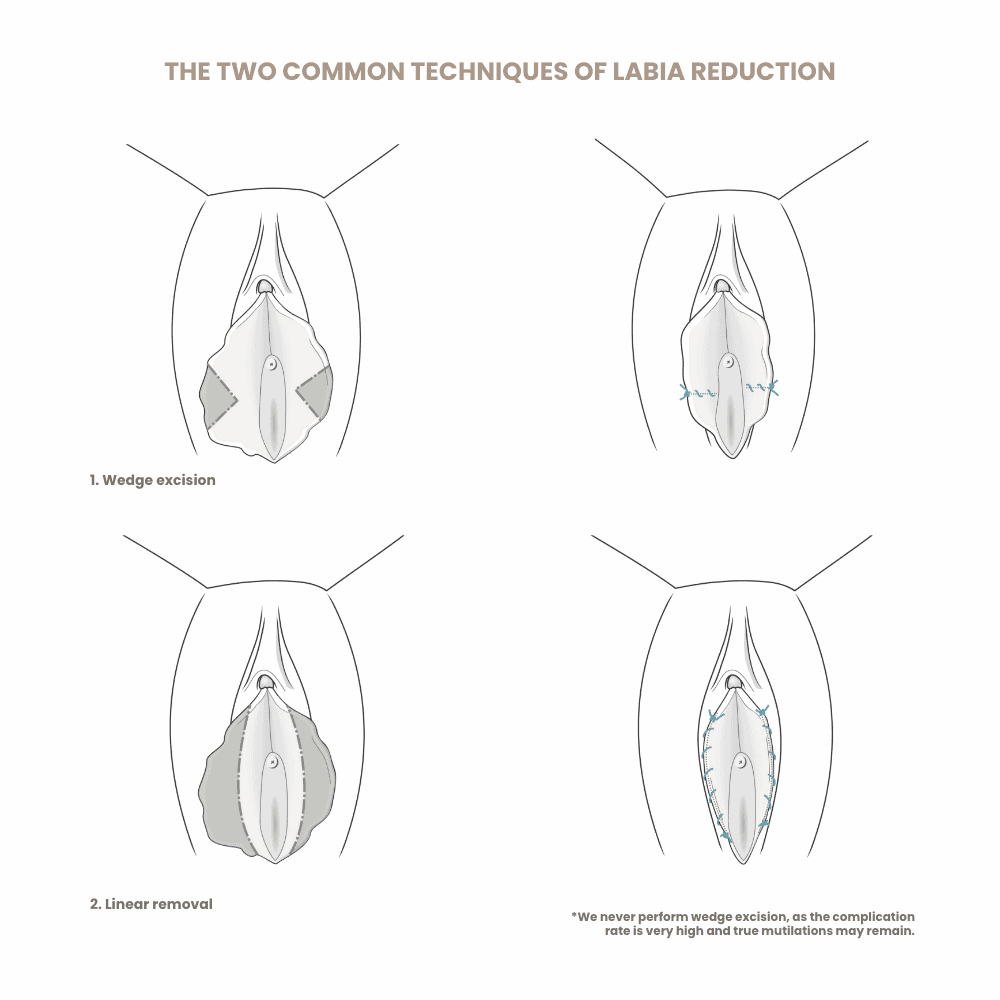
Labia Correction: Legal Aspects and Useful Information
In Austria, as in most European countries, any procedure on the human body that reduces sexual sensitivity is prohibited. This means, of course, that all forms of FGM (female genital mutilation) are strictly forbidden—especially if performed voluntarily or upon request. Accordingly, before a labia correction is performed, the patient must be asked whether the inner labia represent an erogenous zone, and only if this is clearly denied may the surgery be carried out.
The procedure, of course, has nothing to do with female circumcision (FGM)! On the contrary, most of my patients report an improvement in their sex life after a successful operation! The reduction of the inner labia has nothing to do with female circumcision or the removal of the clitoris. Procedures of that nature must be strongly condemned by every reputable medical professional and every human being.
In a labia correction, the clitoris, clitoral hood, and any existing hymen are, of course, left untouched.
Since 2011, there has been a consensus paper by the City of Vienna outlining important guidelines for this type of operation.
Labia Correction: Polarization Is Out of Place!
I hold the view that the correction of the inner labia has the same “justification” as any other aesthetic procedure. All cosmetic surgeries are equally necessary or equally unnecessary. If a woman feels that her labia are bothersome, she should be able to speak openly, without pressure or stigma, with her plastic surgeon or gynecologist about it.







Labia Correction – Overview
Initial Consultation

Have you already purchased the book “Labia Correction” for 40 euros, either at our clinic or online?
nThen the initial consultation for an aesthetic surgical procedure for labia correction is included. A first consultation usually lasts about 30–45 minutes. Without purchasing the book, the consultation is charged at €250. Any longer and more detailed initial consultation (exact duration not fixed) is charged at €300.
Even if you have already had a labia correction performed at another clinic, are dissatisfied with the result, and would like a second opinion, I am happy to advise you. However, I ask for your understanding that in this case, I will charge €300, which will be credited toward a corrective procedure if you choose to proceed.
My personal tip for you: Always seek a second opinion before undergoing any procedure — as a general rule. (Please note: this is not included with the purchase of the book.)
Hospital Stay

Outpatient or inpatient (without/with overnight stay)
€850 to €2800 depending on surgery duration, room category (suite, single, shared), and hospital.
Anesthesia
The procedure is usually performed under sedation (twilight sleep); the anesthesiologist’s fee varies depending on the duration of the surgery, ranging from €400 to €1200. On average, you should expect around €600.
Costs
Depending on the procedures performed (reduction of the inner labia, augmentation of the outer labia, combined procedures), the surgical fee ranges from €1,800 to €6,000. On average, you should expect €3,500 to €4,500.
Surgery Preparation
If the procedure is performed under local anesthesia
For hygiene regulations, a blood test (so-called “small blood panel”) is required, including HIV and Hepatitis A, B, and C. If you are socially insured in Austria and the procedure is medically indicated, there are no additional costs for the blood test.
If the procedure is performed under sedation (twilight sleep)
Pre-operative preparation includes a blood test (so-called “large blood panel”), possibly a chest X-ray, and surgical clearance by a general practitioner or internist. If you are socially insured in Austria and the procedure is medically indicated, there are no additional costs. The same applies to surgical clearance by a general practitioner or internist who has a contract with the standard social insurance providers in Austria. For private doctors, the insurance covers approximately 50%–75% of the costs.
If the procedure is performed under local anesthesia, the following tests should be conducted:
- Complete pre-operative blood panel including blood type, HIV, and Hepatitis A, B, and C
If the procedure is performed under general anesthesia, the following additional tests are required:
- Possibly a chest X-ray
- ECG
- Surgical clearance by a general practitioner or internist
Please note that the tests must not be older than 10 days at the time of surgery. Please bring all findings with you to the hospital on the day of surgery.
Aspirin, Thrombo ASS, and similar medications must not be taken for 14 days prior to the procedure. If necessary, a switch to heparin can be made.
Surgery Checklist
- Plan the surgery date
- Set the surgery date (take vacation/time off or sick leave if needed, plan childcare, etc.)
- Earliest 2 weeks before the surgery: perform preoperative tests (blood work, possibly X-ray, ECG, surgical clearance).
- Preoperative consultation on the day before surgery. The findings will be reviewed, final details discussed, and the consent form signed. A hospital admission form will be given to you by the assistant — it must be completed and brought to the hospital. The first follow-up visit at the clinic will also be scheduled.
- Arrive at the hospital 2.5 hours before surgery – admission formalities. Upon request, a staff member can accompany you and shorten the waiting time before surgery, or at my surgery center according to the time given the day before.
- Discharge from the hospital usually takes place on the day of the surgery. Please do not drive yourself, take a taxi or have someone pick you up.
- At home, rest is required — avoid physically strenuous activities and strictly follow the recommended
- hygiene measures. Sexual activity must be paused for four weeks.
- Follow-up visit (approx. 5–7 days after surgery)
- Follow-up visit (approx. 14 days after surgery): removal of corner stitches
- Follow-up visit (approx. 30 days after surgery)
- Further check-ups after two and six months
- Final check-up after one year
Rounds & Follow-up Appointments
Are included in the surgical fee.
Reviews
What our patients say

Dr. Turkof made my lips more beautiful and symmetrical.
He looked from every angle and only injected the filler where I really needed it. I look natural — if it were possible, I would get more injected.
I know Dr. Turkof through a friend who came all the way from Germany specifically for him. She was very happy with him and recommended him to me, as I was really struggling with dark under-eye circles. My surgery was 3 months ago and I am very pleased with the natural result.
I had two operations with autologous fat transfer to the breast and ribs with Prof. Turkof.
The result is fantastic and I am very satisfied. The quality of Prof. Turkof as a plastic surgeon is, from my perspective, undisputed.
Faq
What is meant by labia correction?
Labia correction refers to the modification of the external appearance of the inner and/or outer labia. In current common usage, the term primarily refers to the reduction of the inner labia.
What correction options exist for the inner labia?
The inner labia can be symmetrized (made even) or reduced in size.
What correction options exist for the outer labia?
The outer labia are usually enlarged with the patient’s own fat to better cover the inner labia or the vaginal entrance. In rare cases, overly large outer labia can also be reduced.
Is labia correction purely an aesthetic procedure, or are there medical reasons for it as well?
Generally, labia correction is a cosmetic procedure, but there can also be functional reasons — such as pain or friction when wearing tight clothing, during sports or cycling, or the inward folding (invagination) of the inner labia during sexual intercourse.
Does health insurance cover the cost of the procedure?
As a rule, since this is an aesthetic operation, public health insurance does not cover it. However, in cases of asymmetry or functional impairment, the procedure may be approved after consultation with the chief medical officer of the health insurance provider.
Is the procedure performed under local anesthesia or general anesthesia?
A labia correction can usually be done under local anesthesia. About 50% of patients, however, choose general anesthesia for comfort reasons — so as not to experience the procedure consciously.
Can the hymen be damaged during labia correction?
No. The hymen remains intact during the correction of the inner labia.
Can the clitoris be injured during labia correction?
No. The clitoris and clitoral hood are never touched during any form of labia correction.
How long is the recovery period after labia correction?
Wound healing is generally complete after two weeks. It is essential to maintain strict hygiene in the intimate area after surgery (e.g., sitz baths after bowel movements, rinsing with Kamillosan or diluted Betaisodona solution after urination, etc.).
nSexual intercourse should be avoided for at least four weeks.
What complications can occur?
In experienced hands, complications are extremely rare. Most relate to aesthetic outcomes (too much, too little, or uneven tissue removal) and have no health consequences. Medical complications such as bleeding, infection, or wound healing issues are also very uncommon.

Contact
Interested in a consultation?
Popular Treatments
Breast augmentation using the patient’s own fat
Gentle breast augmentation using the body's own fat – for a natural shape and harmonious proportions.
Learn moreEyelid Lift in Vienna | Youthful Eyes
A fresher, more alert appearance achieved by removing excess skin from the upper and lower eyelids.
Learn moreFacelift
Facial and neck tightening for a visibly younger, naturally fresh appearance.
Learn moreGynecomastia
Treatment for male breast enlargement to achieve a masculine, flat chest contour and boost self-confidence.
Learn moreRhinoplasty
Aesthetic and functional rhinoplasty for a harmonious facial profile.
Learn more